A Day in the Life of an Institution That Actually Thinks & Learns

In 1999, Walmart launched a website. Amazon was already four or five years old.
Both “used the internet.” Walmart bolted it onto a retail empire. Amazon was built from it. One added a channel. The other reimagined the organism. Twenty-five years later, Walmart has a very good website. Amazon redefined what commerce means.
We are at exactly this inflection point in banking.
Every major bank in the world is now “using AI.” They have chatbots. They have fraud models. They have recommendation engines and document summarizers and AI-powered contact centers. McKinsey published a comprehensive framework for extracting value from AI in banking — a well-sequenced approach to selecting subdomains, deploying multiagent systems, and building a four-layer capability stack across engagement, decision-making, data, and operating model. It’s the best articulation I’ve read of how to build an AI-augmented bank.
But an AI-augmented bank is not an AI-native bank.
An AI-augmented bank adds intelligence to existing processes. An AI-native bank is designed around intelligence from the ground up — where every function, every decision, every customer interaction, and every balance sheet position is informed by intelligence that learns continuously. The augmented bank is Walmart with a website. The AI-native bank is Amazon.
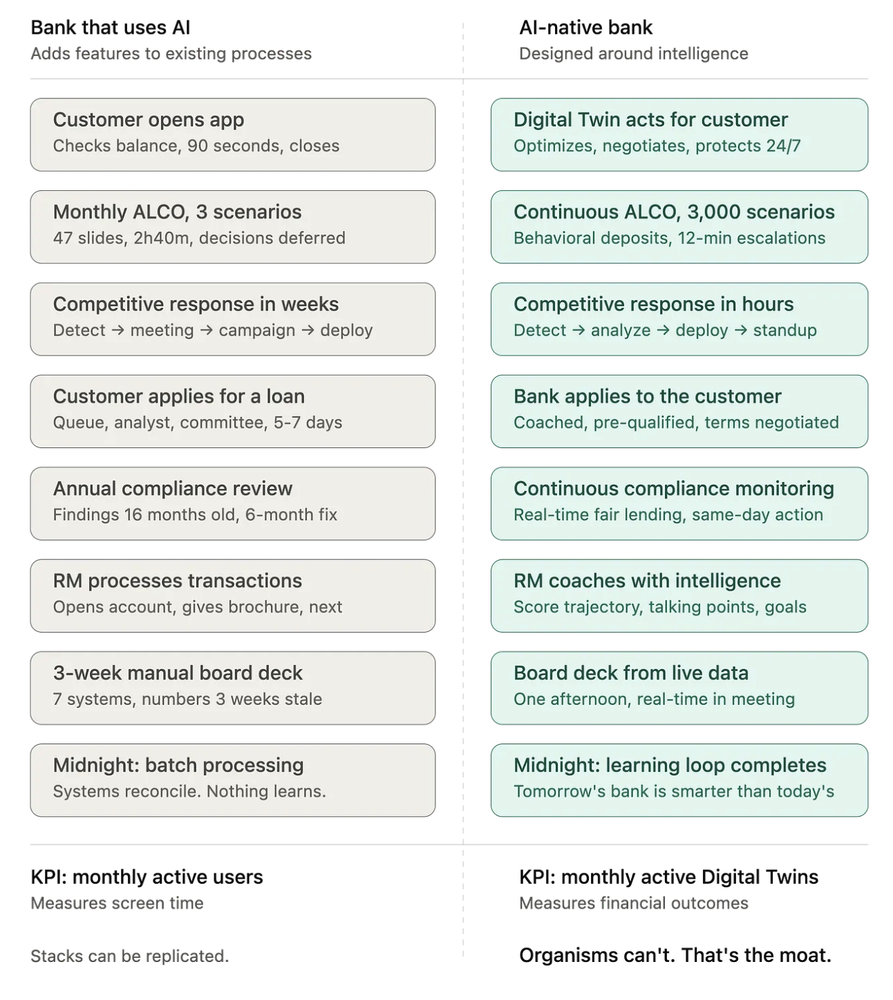
This article describes what an AI-native bank actually looks like — not as an architecture diagram, but as a lived day. The same customers, the same market, the same regulators, the same balance sheet. A completely different organism.
6:00 AM — The Bank Wakes Up Before Human Does
At a traditional bank, nothing happens between midnight and 8 AM except batch processing. Systems reconcile. Reports generate. Tapes run. The bank is asleep.
At an AI-native bank, the overnight hours are the most productive of the day — because the bank is learning.
The behavioral deposit model ingested last night’s rate changes from three competitors and updated the liquidity forecast. The 2–10 spread compressed 8 basis points since Friday’s close; the ALCO monitoring agent pre-computed three hedging responses for the Treasurer, ranked by NII impact. The credit coaching program evaluated 340 customers who crossed the 620 score threshold overnight and queued their graduation into mortgage readiness coaching. The fraud monitoring agent flagged 12 suspicious transaction patterns across the customer base and prepared the morning briefing. The executive command center prepared personalized morning briefings for seven executives — each tailored to their role, their KPIs, and what changed in their domain while they slept.
By the time the first human logs in, the bank has already thought about the day. Not processed — thought. Detected signals. Run simulations. Prepared recommendations. Identified risks. Queued actions.
The traditional bank starts its workday from zero every morning. The AI-native bank starts from last night’s intelligence, compounded by every night that came before it.
7:30 AM — The CEO’s Morning
At a traditional bank, the CEO opens email. Scans overnight reports. Prepares for the 9 AM leadership meeting by reading a 30-page deck that Treasury sent last night. The deck is already stale — it was built on data that’s 48 hours old.
At an AI-native bank, the CEO opens the executive command center — not a dashboard, but a contextually aware AI interface that knows their role, their KPIs, and what changed overnight. Before asking a single question, the system surfaces:
“Three things changed overnight. First: a competitor launched a 5.15% HYS — behavioral deposit model projects 12,400 customers at risk. Response options attached. Second: the credit coaching program graduated 340 customers past the 620 threshold — mortgage readiness pipeline ready for activation. Projected origination: $22M. Third: NII is tracking $1.4M below quarterly forecast — deposit betas lagging by 15 basis points. Two scenarios analyzed.”
The CEO doesn’t prepare for the meeting. The meeting is already prepared for the CEO.
And here’s the shift that matters: the CEO can act in the same session. Not “schedule a follow-up” or “ask Treasury to look into it.” In that same conversation, the CEO can review the competitive response options, approve the mortgage readiness activation, and ask the system to model the NII impact of accelerating a deposit campaign for better managed deposit stickiness. Insight to action in one session. The distance between knowing and doing — which in a traditional bank is measured in days and committees — collapses to minutes.
8:00 AM — The Customer Who Doesn’t Open the App
At a traditional bank, the customer opens the app at 8 AM. Checks balance. Maybe transfers money. Closes the app. Total engagement: one login, 90 seconds. The traditional bank’s dashboard counts this as an “active user.”
At an AI-native bank, the customer’s Digital Twin has been active since midnight.
The Twin moved $2,500 into a 9-month CD at 4.35% — within the customer’s defined Power of Attorney constraints (never let checking drop below $3,000, never lock money for more than 18 months, never accept below 3%). It detected a duplicate streaming subscription (Spotify Premium and Apple Music) and queued a recommendation with a usage comparison. It paid three bills totaling $287, all within the auto-pay limits. It ran the customer’s credit score through the Simulation Engine and confirmed the trajectory: on track to reach 680 by September.
The customer hasn’t opened the app. The customer doesn’t need to. At 8:15 AM, the Twin sends a morning digest:
“Here’s what I did overnight: optimized your CD (projected annual interest +$108), paid three bills ($287), flagged one duplicate subscription (details inside). One item needs your decision.”
The customer reads the digest like they read an executive assistant’s daily report — trusting that the work is done, reviewing what matters, intervening only when judgment is needed.
What the customer doesn’t see — but the bank does — is their deposit stickiness score. Every retail deposit customer in the AI-native bank carries a behavioral score from 0 to 100, updated daily, measuring how likely their balances are to stay. The score isn’t based on the product they hold — it’s based on how they behave: do they receive salary credits? How many products do they hold with us? Do they use digital channels actively? Have they been rate-shopping? Is their balance trending up, flat, or declining?
This customer scores 84 — Tier A, “stable operational core.” She has salary credit, three active products, daily mobile engagement, and her balance has been trending up for six months. The Twin knows this. That’s why it confidently locked $2,500 in a 9-month CD — the Simulation Engine verified that her behavioral profile makes early withdrawal virtually impossible. For a customer scoring 33 — Tier D, “dormant drifter” with declining balance and no salary credit — the Twin would never recommend locking funds. It would recommend the opposite: a re-engagement nudge.
The same stickiness score that informs the Digital Twin’s customer-level decisions feeds upward into the balance sheet. Every deposit in the bank isn’t just a balance — it’s a behavior.
The most engaged customer at the AI-native bank is the one who opens the app least — because their agent is doing the work for them, 24 hours a day, compounding value with every action.
The metric that matters isn’t Monthly Active Users. It’s Monthly Active Digital Twins.
9:00 AM — The ALCO That Isn’t a Meeting
At a traditional bank, ALCO meets on the third Tuesday of every month. Forty-seven slides. Three rate scenarios (up 100, flat, down 100 — parallel shifts only). The securities duration debate takes 35 minutes and ends with “let’s revisit next month.” The meeting runs 2 hours and 40 minutes. The market moves 15 basis points that afternoon. Nobody reconvenes.
At an AI-native bank, there is no monthly ALCO meeting. There is a continuous ALCO capability.
The Treasurer’s command center interface shows the balance sheet Digital Twin running 3,000 Monte Carlo scenarios in real-time — not just parallel rate shifts, but curve twists, inversions, and correlated credit spread movements. But the real transformation isn’t the scenario count. It’s what feeds the scenarios: behavioral deposit intelligence built from the same customer data that powers the Digital Twins downstairs.
Every deposit in the bank is classified into behavioral segments — not by product type (term deposit, fixed deposit, savings, CASA) but by how the money actually behaves: stable operational core (salary credits, multiple products, rising balances), rate-chasers (promo-driven, re-decide at every maturity), transactors (high activity, moderate stickiness), dormant drifters (declining engagement, balance erosion), and at-risk decliners (interbank transfers increasing, salary credits stopped). Each segment has a measured behavioral maturity that’s completely different from its contractual maturity.
A term deposit with a 12-month contractual maturity held by a Tier A “stable core” customer has a behavioral maturity closer to 36 months — the data shows they’ll roll over. The same product held by a Tier E “rate-chaser” has a behavioral maturity closer to 30 days — the moment a competitor offers 15 basis points more, that money moves. Traditional ALM treats both deposits identically. The AI-native ALCO sees them as fundamentally different funding instruments.
The system also runs a maturity wall — not the static contractual maturity schedule that traditional ALM uses, but a behavioral prediction: of the deposits maturing in the next 30, 60, and 90 days, how many will actually roll over, and how many will leave? The gap between “maturing” and “predicted retained” is the defend-or-lose number — the precise amount of funding the bank needs to fight for through retention, re-pricing, or replacement.
And at the customer level, the early-warning model generates a daily flight-risk work list: specific customers, ranked by probability of material outflow, with human-readable reason codes (“promo rate expiring in 12 days,” “salary credit stopped,” “interbank transfers to competitor rising,” “FD maturity with no rollover set”) and a recommended retention action for each. A flag becomes an action — not a slide in next month’s ALCO deck.
This morning, the system escalated: “Deposit concentration breached the early warning threshold — top-20 concentration moved from 14.2% to 16.8% this week. Two options analyzed. Option A: activate wholesale funding backup ($X cost, 48-hour availability). Option B: accelerate retail deposit campaign in the Southeast region (projected $12M inflow over 30 days). Recommended: Option B based on current liquidity headroom.”
The Treasurer reviews, selects a strategy, and the system executes. Total time: 12 minutes. The ALCO committee convenes only when the system detects something that exceeds its delegated authority — a signal-driven meeting, not a calendar-driven ritual.
The balance sheet — the single most consequential risk surface in the bank — is no longer managed by a monthly committee reviewing stale reports. It’s managed by a continuous intelligence system that sees behavioral reality, not contractual fiction.
And here’s the part that surprises most bank executives: the risk modeling infrastructure to build this already exists in open source. The Open Source Risk Engine (ORE) — built on QuantLib and now at version 16 — provides production-grade exposure simulation, multi-factor rate modeling, stress testing, and XVA analytics. Global investment banks have already validated it as a replacement for commercial risk engines at a fraction of the cost. The scenario generation, the yield curve modeling, the Monte Carlo simulation framework — these are solved problems. What no open source project provides is the behavioral layer: the deposit stickiness scoring, the customer signal integration, the flight-risk work list. That’s the intelligence a bank builds on top of the open infrastructure. The foundation is free. The intelligence is the moat.
10:00 AM — The Competitive Response That Takes Hours, Not Weeks
At a traditional bank, the Head of Retail learns about the competitor’s 5.15% HYS launch from an alert. Schedules a meeting with marketing. Briefs the campaign team on Wednesday. Reviews creative next week. Deploys the response in 2–3 weeks. By then, 4,000 customers have already left.
At an AI-native bank, the executive command center surfaced the competitive threat at 7:30 AM — before any human at the competitor’s bank had even started their victory lap.
By 10 AM, the response is deployed. Here’s how:
The system identified the threat (competitor rate launch + 142 savings closures over the weekend + 12,400 customers matching the at-risk profile). It presented three response options with cost/impact projections: rate match ($2.1M annual cost, 85% retention), targeted retention ($340K for 90 days, 60% retention), or coaching enrollment (minimal cost, 70% retention, 0% churn for coaching-enrolled customers). Recommendation: combine targeted retention with coaching enrollment.
The Head of Retail selected the combined strategy. The campaign — targeting, creative variants, channel sequence, A/B test configuration — was assembled by the engagement orchestration engine and deployed through the bank’s digital platform. All before the 9 AM standup.
The Head of Retail asked the command center to generate a 35-second talking point about the competitive response. Walked into the leadership meeting looking like she’d been on top of it all weekend.
The traditional bank that responds in weeks loses 4,000 customers. The AI-native bank that responds in hours loses 200. The difference isn’t speed. It’s intelligence — the system detected the threat, analyzed the customer impact, generated options, and deployed the response in a single, continuous motion.
11:00 AM — The Loan That Approves Itself
At a traditional bank, the customer applies for a personal loan. The application enters a queue. A credit analyst reviews it in 2–3 business days. A committee approves. Documents are prepared. Funds arrive in 5–7 days.
McKinsey’s framework shows how AI transforms this process: the credit manager evolves from manual orchestration (handling every step) through AI-copilot (AI assists with document collection, summarization, and evaluation while the human handles customer interaction and judgment calls) to AI-agent (AI handles most tasks autonomously while the human steps in for relationship moments and final decisions). It’s the right progression.
But it stops at the bank’s boundary. The evolution is inside the institution. The customer is still the one who initiates.
At an AI-native bank, the customer didn’t apply. The bank applied to the customer.
Here’s what actually happened: the bank’s AI financial coach has been guiding this customer through a credit-building program for 8 months. Score improved from 580 to 668. DTI dropped to 29%. Income stability confirmed by 16 consecutive months of salary credits. The financial planning agent identified that a personal loan for debt consolidation would reduce the customer’s total monthly payments by $140 and accelerate their path to mortgage readiness.
The Digital Twin’s Negotiation Agent evaluated three loan products from the bank’s catalogue. It counter-offered on the customer’s behalf: “My client has $45K in deposits and an 8-month coaching history. Reduce the rate by 50 basis points and they’ll accept.” The bank’s product recommendation engine evaluated the lifetime value: the customer is on a trajectory toward mortgage origination within 18 months. The rate discount is an investment in a high-value relationship. Approved.
The Twin presented the pre-approved, pre-negotiated offer: “Based on your financial progress, you qualify for a $15K personal loan at 7.2% (negotiated from 8.1%). Monthly payment: $294. This consolidates your three card balances and reduces your total monthly payments by $140. Accept?”
The customer tapped yes. Funds arrived the same day.
No application. No queue. No analyst. No committee. The customer was coached into readiness, the terms were negotiated by their agent, and the product was delivered at the moment of maximum readiness.
This is what McKinsey’s framework doesn’t capture: the AI evolution isn’t just inside the bank. It’s bilateral. The customer has an agent. The bank has agents. They negotiate. The result is better for both sides — the customer gets a better rate, the bank gets a higher-value, pre-qualified borrower with lower default risk.
1:00 PM — The CRO’s Continuous Compliance
At a traditional bank, fair lending analysis runs annually. The results arrive 4 months after year-end. They identify issues that have been compounding for 16 months. The remediation plan takes another 6 months. Total time from issue to fix: 22 months.
At an AI-native bank, the AI governance system runs fair lending analysis continuously — across every coaching program, every product recommendation, every credit decision, every Digital Twin negotiation.
At 1 PM, the system flags: “Credit-builder loan recommendations showing 11% disparity across demographic segments in the Southeast region. Root cause analysis: product availability gap, not algorithmic bias. Three branches don’t offer the product. Recommended remediation: expand product availability to affected branches. Evidence bundle attached.”
The CRO reviews, approves the remediation, and the finding is documented with full audit trail — input data, model factors, policy evaluation, SHAP explainability scores — all before the issue becomes a pattern that an examiner discovers a year from now.
Every AI-driven decision in the bank produces a complete evidence bundle: the signals detected, the state evaluated, the policies applied, the rationale generated, the outcome recorded. When the examiner asks “why did your system recommend Product X to Customer A but not Customer B?”, the answer isn’t “the committee discussed it.” It’s a specific, traceable chain of intelligence.
The CRO at an AI-native bank doesn’t have an easier job. They have a possible job. Auditing millions of AI-driven decisions without AI governance is like auditing every trade on a stock exchange by reading paper tickets. The governance system makes it possible by producing the evidence that human-only processes never could.
3:00 PM — The Branch That Coaches Instead of Transacts
At a traditional bank, the branch RM meets a customer who wants to open a savings account. Opens the account. Gives a brochure. Moves to the next customer. Interaction: transactional, forgettable, no follow-up.
At an AI-native bank, the RM’s tablet shows the coaching intelligence briefing before the customer sits down:
“This customer has been in the credit-building program for 6 months. Score improved from 540 to 610. DTI dropping. Has expressed homeownership intent (in-app searches detected). Approaching mortgage readiness eligibility. Key talking points: congratulate score improvement, introduce the path to mortgage pre-qualification, discuss savings acceleration options.”
The RM doesn’t just open a savings account. They have a coached conversation about the customer’s financial trajectory — informed by intelligence the RM couldn’t have assembled alone. The customer leaves feeling known. Not sold to. Known. The difference between those two feelings is the difference between a transaction and a relationship.
This is Eric Topol’s insight from Deep Medicine applied to banking: AI shouldn’t replace the human interaction. It should handle the pattern work — score analysis, product eligibility, behavioral signals, talking point preparation — so the human can go back to being human. Deep intelligence plus deep empathy. The RM becomes the human expression of the Intelligence Layer, armed with insights that make them appear brilliant.
The RM at a traditional bank is a transaction processor who happens to be a person. The RM at an AI-native bank is a relationship builder armed with intelligence that no person could compile alone.
5:00 PM — The Board Report That Writes Itself
At a traditional bank, the CFO’s team spends 3 weeks building the quarterly board deck. Data pulled from seven systems. Numbers reconciled manually. Slides formatted. Draft reviewed by three layers of management. By the time the deck reaches the board, the numbers are 3 weeks old.
At an AI-native bank, the executive command center generates the board deck from live data. Coaching program ROI — computed from actual product origination attributed to coaching-graduated customers. NII performance — from the balance sheet Digital Twin’s real-time model. Competitive positioning — from the market monitoring system’s continuous tracking. Customer health metrics — from the coaching system’s behavioral analytics. Risk dashboard — from the governance system’s continuous compliance monitoring.
The CFO reviews, adjusts emphasis, adds strategic commentary, and approves. Total preparation time: one afternoon instead of three weeks. The numbers on the slides match the numbers in the command center because they come from the same source. When a board member asks “what’s the latest on the competitive response?”, the CFO pulls up real-time campaign results — not last month’s snapshot.
The board meeting transforms from a reporting ritual to a strategic conversation — because nobody spends time debating whether the numbers are right.
7:00 PM — The Customer Actually Engages
At a traditional bank, the app goes quiet after business hours. The bank’s operations are 9-to-5. Customer engagement after dinner is a push notification that gets swiped away.
At an AI-native bank, 7 PM is the highest-value hour of the day.
This is peak mobile engagement — the window when customers are home, reflective, and willing to think about their financial lives. The coaching system knows this. The engagement engine has learned, customer by customer, that the 7–9 PM window produces 3x the engagement rate of any daytime nudge for working professionals.
This is when the twin delivers its daily digest. Not a notification — a report. “Here’s what I did today. Here’s one thing that needs your decision.” The customer reviews the CD optimization, scans the bill payments, reads the duplicate subscription comparison. Some approve. Some adjust a constraint (“increase my liquidity floor to $5,000”). Some expand the Twin’s authority (“go ahead and auto-pay anything under $150 from now on”).
Each of these interactions generates the most valuable behavioral data in the entire system — not passive data (the customer checked their balance) but preference data (the customer explicitly told the Twin what they want, what they trust it with, and what they don’t). This is the data that trains the personalization models. This is the data that no competitor can replicate. And it’s generated not during business hours when the bank is busy pushing campaigns, but during evening hours when the customer is reflective and honest about what they actually care about.
The traditional bank’s engagement team goes home at 6 PM. The AI-native bank’s most important customer conversation happens at 7:15 PM, on the couch, in 90 seconds.
9:00 PM — The Risk Officer Who Sleeps Through the Night
At a traditional bank, the CRO’s biggest fear is the 2 AM phone call. A system failure. A fraud event. A liquidity breach. A regulatory threshold crossed. The traditional bank’s risk infrastructure is built to detect problems after they become crises — and then wake a human to fix them.
At an AI-native bank, the 2 AM phone call doesn’t happen — because the 4 PM escalation already handled it.
By 9 PM, the end-of-day risk cycle is complete. The behavioral deposit model has recalculated stickiness scores for every retail customer using today’s transaction data — balance movements, salary credits received or missed, interbank transfers, new product activations, and account closures. The maturity wall has been updated: deposits maturing in the next 30, 60, and 90 days now reflect today’s behavioral signals, not last month’s contractual assumptions. The flight-risk worklist for tomorrow is staged — 23 customers flagged, each with a probability score, a reason code, and a recommended retention action assigned to a specific owner.
The ALCO monitoring agent has updated the liquidity forecast with today’s deposit flows and tonight’s rate market close. If any threshold is approaching breach, the escalation already fired — at 4 PM, when the Treasurer could act, not at 2 AM, when the only option is a phone tree.
The fraud system has completed its daily pattern review across the full customer base. Twelve flagged patterns from this morning have been resolved — eight cleared as legitimate, four escalated to investigation with evidence bundles attached. Tomorrow’s fraud briefing is already staged.
The CRO sleeps through the night. Not because the risks don’t exist — but because the AI-native bank governs while humans rest. Every risk that could become a 2 AM crisis was detected, evaluated, and either resolved or escalated during business hours, by systems that never take a break, never lose context, and never forget to check.
The traditional bank’s risk management is reactive: something breaks, someone gets called. The AI-native bank’s risk management is preemptive: something shifts, the system responds before it breaks.
11:00 PM — The Bank That Never Stops Learning
At a traditional bank, the systems run batch processing overnight. Tapes reconcile. Nothing learns. Tomorrow’s bank is exactly as smart as today’s.
At an AI-native bank, the learning loop completes its daily rotation.
Every customer interaction today generated training data that improves tomorrow’s models. The engagement engine’s Thompson Sampling updated channel preference distributions for 50,000 customers based on today’s engagement data. The behavioral deposit model incorporated today’s deposit flows and recalibrated maturity estimates across 14 customer segments. The credit coaching program’s planning agent refined its roadmap strategies based on today’s milestone outcomes — learning which action sequences produce the fastest score improvement for each customer profile.
The financial coach is slightly smarter at 11 PM than it was at 6 AM. Tomorrow, it will be smarter still. And the day after that. And the day after that.
This is the compound learning loop that most AI banking frameworks — including McKinsey’s comprehensive stack — describe aspirationally but don’t architect mechanically. The stack describes the components. The organism describes the loop:
Signal → Detect → Predict → Act → Observe → Learn → Improve → Signal.
Every rotation makes the next rotation better. Every day the AI-native bank operates, the gap between it and the AI-augmented competitor widens.
Stacks don’t compound. Organisms do.
The Three Differences That Define an AI-Native Bank
The day I’ve described above isn’t science fiction. Every component — the executive command center, the financial coach, the Digital Twin, behavioral ALCO, the AI governance layer, the learning loop — is architecturally specified and, in several cases, prototyped. The technology exists. The question is organizational, not technical.
Three structural differences separate an AI-native bank from an AI-augmented one:
Difference 1: The Organizational Design
An AI-augmented bank has an AI team. An AI-native bank doesn’t — because AI is in every team.
The CDO at an AI-augmented bank manages data. The CDO at an AI-native bank runs the intelligence supply chain — the signal catalogue, the behavioral models, the knowledge graph that every agent in the bank queries in real-time.
The CRO at an AI-augmented bank reviews annual compliance reports. The CRO at an AI-native bank governs continuous AI decision-making — monitoring the governance system’s evidence bundles, calibrating autonomy levels, expanding or constraining what agents can do based on observed performance.
The Head of Retail at an AI-augmented bank manages channels — mobile, web, branch, contact center. The Head of Retail at an AI-native bank manages a portfolio of coaching programs and a fleet of Digital Twins — measuring financial health improvement, autonomous optimization value, and negotiation acceptance rates.
There’s no “digital transformation team” because there’s nothing left to transform. The bank IS the intelligence. Asking “who runs our AI?” at an AI-native bank is like asking “who runs our electricity?” at a modern company. Everyone uses it. Nobody owns it as a separate function. The infrastructure team maintains it. Every function depends on it.
Difference 2: The Metrics
An AI-augmented bank measures what McKinsey’s framework measures: use cases deployed, productivity gains per subdomain, models in production, and — at the top line — cost reduction and revenue uplift. These are legitimate metrics. They’re also inputs, not outcomes.
An AI-native bank measures outcomes:
Active Digital Twins — not Monthly Active Users. How many customers have an AI agent operating on their behalf, 24/7, optimizing, negotiating, and protecting.
Autonomous Optimization Value — the measurable dollar impact of Twin-executed actions. Additional interest income earned, fees avoided, subscription waste eliminated. “Customers with active Twins earned an average of $847 more per year.”
Negotiation Acceptance Rate — not banner conversion rate. When the customer’s Twin negotiates terms with the bank’s product recommendation engine, what percentage results in product activation. Expect 4–6x improvement over traditional offer conversion.
Customer Financial Health Score Change — measurable improvement in credit score, savings rate, DTI, and insurance coverage attributable to the coaching system. The metric that proves financial health and revenue growth are the same motion.
Twin-Attributed Revenue — total revenue from products and actions the Digital Twin directly influenced. Not “digital channel revenue.” Precise attribution.
POA Expansion Rate — how many customers are expanding their Twin’s autonomy over time. This measures trust — the compound asset no competitor can replicate.
Churn Rate: Twin-Active vs. Non-Active — the attrition differential that proves the switching cost the Twin creates.
The AI-augmented bank’s board deck says: “We deployed 47 AI use cases and achieved 23% productivity improvement in credit underwriting.”
The AI-native bank’s board deck says: “Our platform made customers an average of $847 wealthier this year. Twin-mediated product acceptance is 4.2x higher than direct offers. Twin-active customers have 0.3% churn versus 4.1% for non-active. Coaching-attributed mortgage origination: $22M this quarter.”
One measures technology adoption. The other measures lives improved and revenue earned.
Difference 3: The Moat
An AI-augmented bank has a technology advantage. AI-native bank has a compound advantage.
The technology advantage is real but replicable. A well-funded competitor can deploy chatbots, fraud models, multiagent systems, and copilots within 18–24 months. McKinsey’s framework is public. The architecture patterns are known. The cloud providers sell the infrastructure.
The compound advantage is unreplicable. Every day the AI-native bank operates, its models get better — because every customer interaction, every executive decision, every Digital Twin action, every ALCO simulation generates training data that improves the next iteration. The behavioral deposit model that’s been learning from 2 years of customer behavior can’t be replicated by a competitor who deployed their model last month. The financial coach that has 8 months of credit coaching outcome data can’t be matched by a competitor launching their coaching product today. The Digital Twin that has earned a customer’s trust through 200 successful autonomous actions can’t be transferred to a competitor’s platform overnight.
This is the Netflix recommendation engine dynamic. Netflix didn’t win because its algorithm was better than Blockbuster’s (Blockbuster didn’t have one). Netflix won because every movie watched made the recommendation engine smarter, which made customers watch more, which made the engine smarter. The compound loop created an advantage that widened every day.
The AI-native bank creates the same dynamic. Every coaching interaction improves the coach. Every Twin action improves the Twin. Every ALCO simulation improves the ALCO. Every day, the gap between the AI-native bank and the AI-augmented competitor widens — not because the AI-native bank is spending more, but because its intelligence is compounding.
Stacks can be replicated. Organisms can’t. That’s the moat.
The Path From Here to There
I want to be honest about what this article describes: an end state, not a starting point. No bank becomes AI-native overnight. The transformation follows a sequence — and as I’ve written about separately, that sequence draws from the neuroscience of how complex systems heal and adapt. You can’t skip stages without creating fragility.
Phase 1: Stabilize the foundation (Months 1–6). Fix the operating basics. Clarify roles and decision rights. Stabilize the data infrastructure. Implement the signal catalogue. This is the unsexy work that makes everything else possible. Most transformation programs skip it. Most transformation programs fail.
Phase 2: Activate the learning loop (Months 6–12). Deploy the first coaching program (start with credit card activation or credit score building). Connect customer data signals to the coaching system. Measure outcomes against a control group. Prove the 90-day thin slice. This is where the organism starts breathing.
Phase 3: Extend intelligence to the balance sheet (Months 12–18). Build behavioral deposit models. Connect customer signals to ALM. Replace three ALCO scenarios with three thousand. Show the committee the gap between contractual and behavioral maturity. The infrastructure to do this isn’t hypothetical — open source risk engines like ORE already provide the rate modeling and simulation framework that took commercial vendors decades to build. Your team builds the behavioral intelligence on top. This is where the CFO becomes a believer.
Phase 4: Deploy the executive layer (Months 12–24). Launch the executive command center for the Head of Retail and CFO. Collapse the distance between insight and action. Demonstrate the competitive response speed. This is where the CEO becomes a champion.
Phase 5: Activate bilateral intelligence (Months 24–36). Deploy the Digital Twin. Start with Monitor Only. Graduate to Recommend & Act. Activate the Negotiation Agent. This is where the customer becomes an advocate — because their bank now has an agent working for them.
Phase 6: Compound (Month 36+). The learning loop has been running for 2+ years. The models are trained on your customers, your market, your competitive dynamics. The Digital Twins have earned trust. The coaching system has graduated thousands of customers into new products. The ALCO system has navigated multiple rate cycles with behavioral precision. The gap between you and every competitor who started later is now structural, not tactical.
The bank that starts Phase 1 today will be in Phase 4 by 2028. The bank that waits for a “comprehensive AI strategy” will still be in Phase 1 in 2029, by which time the compound advantage of the early mover will be insurmountable.
The Difference That Defines the Next Decade
The difference between a bank that uses AI and an AI-native bank is the same difference between a horse-drawn carriage with a motor bolted on and an automobile.
Both move. One was designed around the motor. The other accommodates it.
The carriage with a motor is faster than the horse. The automobile changed where people live, how cities are built, and what the economy looks like. The improvement wasn’t incremental. It was categorical.
AI-native banking won’t just make banks more efficient. It will change what a bank is. A bank that coaches customers toward financial health — and earns revenue as a direct consequence. A bank where the customer has an agent that negotiates on their behalf. A bank where the balance sheet manages itself between committee meetings. A bank where compliance runs continuously, not annually. A bank where the board deck writes itself from live data. A bank where every midnight, the institution learns from everything that happened today and becomes slightly better for tomorrow.
The banks that build this won’t be the ones with the biggest technology budgets. They’ll be the ones with the discipline to sequence the transformation correctly, the patience to let new capabilities consolidate before launching the next wave, and the conviction that the compound learning loop — not any single AI feature — is the moat that lasts.
McKinsey is right that banks need to rewire the enterprise. But rewiring implies the structure stays the same. What I’m describing is a new organism. One that thinks, learns, acts, and compounds.
The banks that understand this distinction will define the next decade. The ones that don’t will be reading about it in analyst reports, wondering why their AI chatbot didn’t save them.