A Persian carpet takes between eight months and four years to make. Not in a factory — on a loom, by hand, knot by knot. A single square meter contains between 120,000 and 800,000 hand-tied knots, each one a decision about color, tension, and density made by an individual weaver in real time.
Here’s the part most people don’t know: a large carpet isn’t woven by one person. It’s woven by many — sometimes dozens of weavers sitting side by side at a single loom, each responsible for their section of the pattern. No weaver sees the full carpet while weaving. They see their row, their knots, their small rectangle of the emerging design. They make hundreds of micro-decisions per hour: how tightly to pull this knot, whether this shade of indigo should be one degree darker to account for the way natural dye fades over the first decade, how to handle the millimeter where their section meets their neighbor’s section.

There is no real-time communication between weavers about these decisions. No project manager walking the loom. No quality control checkpoint after every row. No standup meeting.
And yet the finished carpet is coherent. Not approximately coherent. Perfectly coherent — the kind of coherence that makes a 200-year-old Tabriz carpet worth more than most cars, because the transitions between weavers are invisible, the color gradients are seamless, and the overall pattern reads as though one mind conceived it and one hand tied every knot.
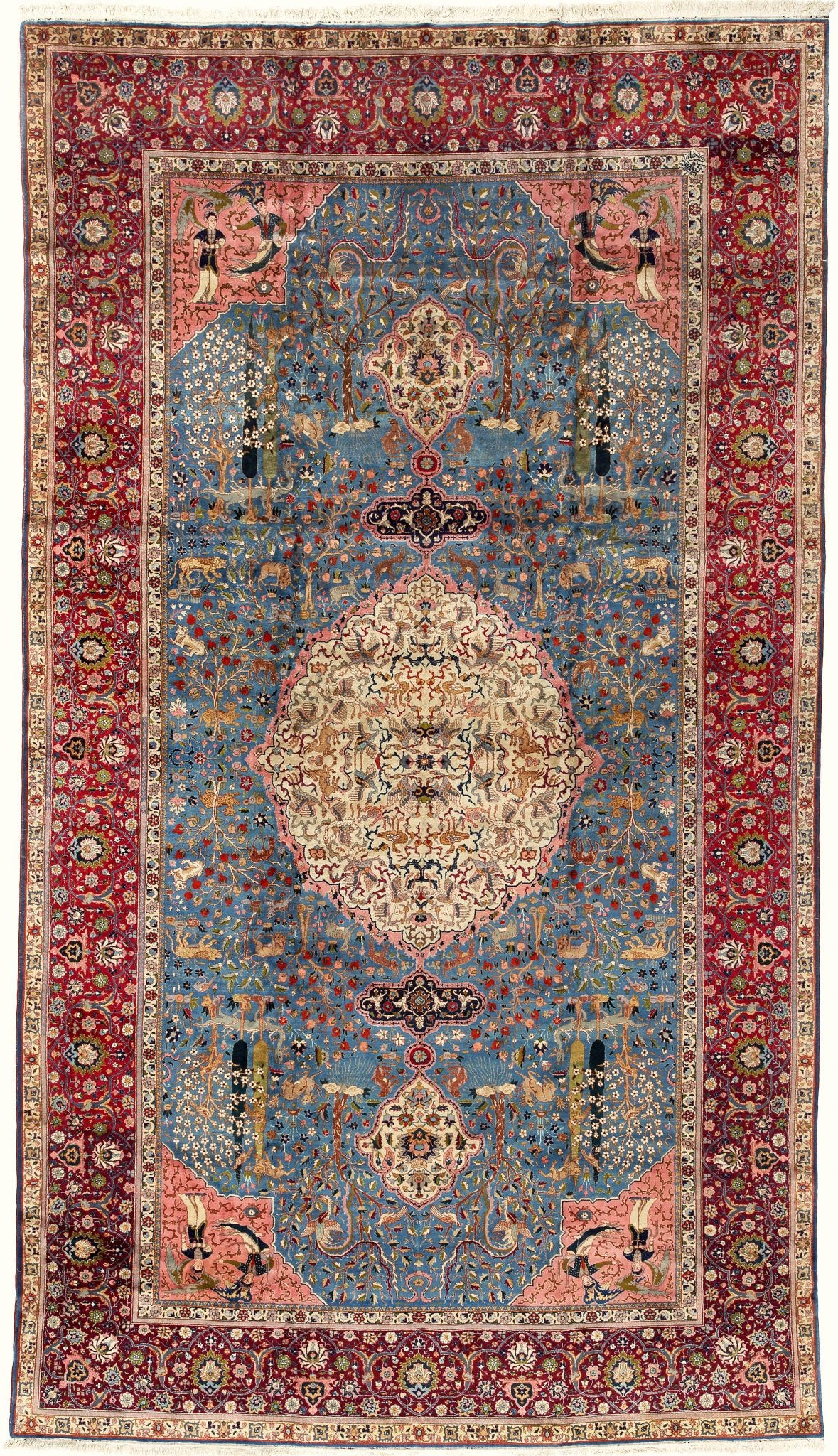
I grew up around these carpets. It took me 30 years to realize they were teaching me about distributed intelligence.
The Architecture Nobody Notices
The coherence of a Persian carpet is not a miracle. It’s an architecture — and it solves the same problem that the most sophisticated AI systems in the world are struggling with right now: how do you produce coherent outcomes from multiple independent agents, each operating with local information, without a central controller bottlenecking every decision?
In AI, this is the multi-agent coordination problem. In organizational design, it’s the autonomy-vs-alignment problem. In distributed computing, it’s the consistency problem. Every field has its own name for it. The carpet solved it eight centuries ago.
The solution has four principles. Each one maps precisely to a modern AI architectural challenge — and each one reveals why most banks’ AI strategies produce fragmented results despite individually excellent components.
Principle 1: The Cartouche — Intent Without Micromanagement
Before the first thread is tied, the master weaver creates the cartouche — the master pattern. The cartouche isn’t a pixel-by-pixel instruction manual. It’s a design language: the structural zones of the carpet (border, field, medallion, corner spandrels), the color palette (which dyes, which combinations, which transitions are permitted), the motif vocabulary (which symbols appear, what scale, what density), and the compositional rules (symmetry axes, repetition intervals, how the medallion relates to the border).
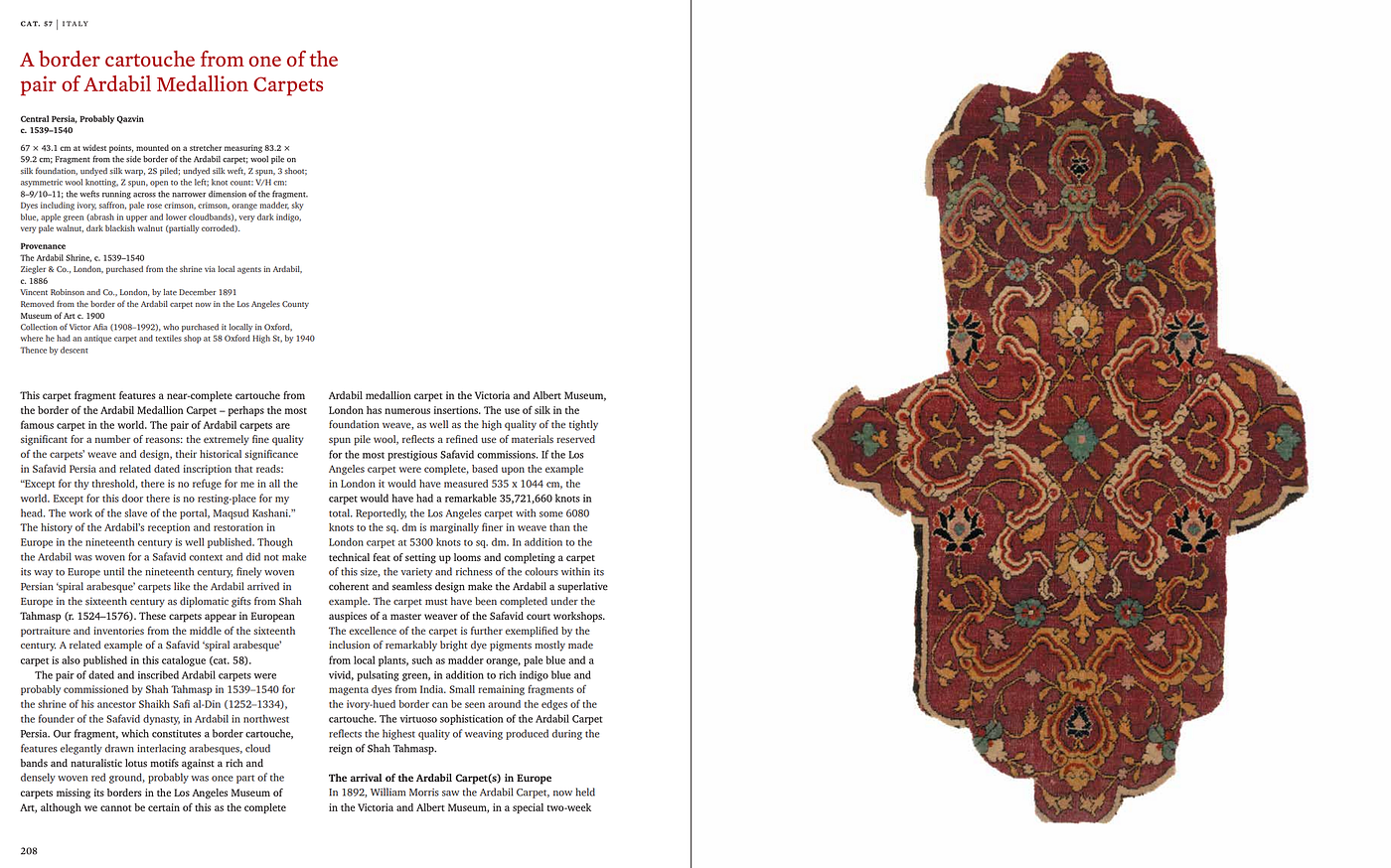
The cartouche tells each weaver what the carpet should become. It does not tell them how to tie each knot.
This distinction is the entire architecture.
A cartouche that specified every knot would be useless — it would take longer to read than to weave, it couldn’t account for variations in thread thickness or dye absorption, and it would reduce skilled weavers to mechanical followers of instructions. The carpet would be technically correct and artistically dead. It would look machine-made — because, cognitively, it would be.
A cartouche that specified nothing would produce chaos — each weaver interpreting the assignment differently, colors clashing at the boundaries, motifs at inconsistent scales, a carpet that looks like it was woven by committee. Which, without the cartouche, it was.
The cartouche occupies the space between: enough structure to produce coherence, enough freedom to produce intelligence.
The AI parallel: Most AI systems in banking are deployed without a cartouche. A chatbot handles customer inquiries. A fraud model scores transactions. A recommendation engine suggests products. A credit scoring system evaluates risk. Each one is individually well-built — a skilled weaver tying excellent knots. But there is no shared design language that tells all of them: what is this bank trying to become? What customer outcomes are we optimizing toward? What is the relationship between what the chatbot says and what the recommendation engine suggests? What happens at the boundary between the fraud model’s risk assessment and the credit model’s approval decision?
Without the cartouche — the shared intent layer that defines the bank’s financial coaching philosophy, its customer health objectives, and its product strategy as a unified design — each AI agent optimizes locally and the overall experience is incoherent. The customer gets a fraud alert and a product offer in the same session. The chatbot recommends saving more while the recommendation engine suggests a new credit card. The credit model tightens lending while the marketing model increases acquisition spending in the same segment.
Every knot is well-tied. The carpet doesn’t compose.
The first principle: define the cartouche before you deploy the weavers. In AI terms: define the intent layer — the financial coaching philosophy, the customer outcome metrics, the shared signal catalogue, the design language that all agents reference — before you deploy a single model. The intent layer is not a strategy document. It is a computable architecture that every agent queries before acting.
Principle 2: Local Autonomy Within Shared Constraints
Each weaver on the loom is an autonomous agent. They choose knot tension based on the thread they’re holding — not the thread three sections away. They adjust color density based on how the dye absorbed into their particular batch of wool. They handle the edge of a motif differently at the carpet’s border than in the field, because the visual weight needs to be different. These are judgment calls, made in real time, by skilled practitioners who understand the medium at a level that no instruction manual can capture.
But — and this is critical — the autonomy operates within the constraints of the cartouche. No weaver invents a new motif. No weaver introduces a color that isn’t in the palette. No weaver changes the symmetry structure. The constraints are non-negotiable. The autonomy operates entirely within them.
This is not a compromise. It’s a design principle. The constraints don’t limit the weaver’s intelligence — they focus it. A weaver who must choose from twelve permitted shades of blue produces more sophisticated color work than a weaver who can choose any color, because the constraint forces them to find subtlety within a restricted palette. The limitation becomes the craft.
The AI parallel: In a well-designed multi-agent banking system, each agent — credit coaching, savings optimization, product recommendation, fraud detection, deposit management — operates autonomously with local data. The credit coaching agent sees this customer’s score trajectory, spending patterns, and debt structure. The savings optimizer sees their balance history, salary timing, and savings goals. Each agent makes decisions using information the others don’t have. That’s the local autonomy.
But all of them operate within shared constraints: the governance framework (what actions require human approval, what autonomy levels are permitted, what audit trail is required), the signal catalogue (the shared vocabulary of customer events that all agents recognize and respond to), and the customer’s own consent boundaries (what domains the system may act in, what limits the customer has defined).
The governance framework is the color palette. The signal catalogue is the motif vocabulary. The customer’s consent is the compositional rule. Within those constraints, each agent exercises local judgment — the same way each weaver exercises local craft within the cartouche.
The second principle: autonomy without constraints produces chaos; constraints without autonomy produce rigidity. The carpet achieves both — coherent and alive. That’s the target for any multi-agent AI system: agents that are free enough to be intelligent and constrained enough to be coherent.
Principle 3: Coherence Without Central Control
The most remarkable thing about a Persian carpet isn’t any individual section. It’s that the sections compose.
The transition between one weaver’s zone and the next is seamless. Not because someone inspected the joint and corrected misalignments. Not because a supervisor stood behind each weaver comparing their work to their neighbor’s. The transition is seamless because both weavers were working from the same pattern language — and the pattern language was precise enough that two independent interpretations, made without communication, arrive at the same boundary conditions.
This is, computationally, an extraordinary achievement. It means the cartouche encodes not just the overall design but the transition rules — what happens when a motif reaches the edge of one zone and enters another. The color palette doesn’t just specify “use this blue.” It specifies: “when this blue meets the border, it transitions through these three intermediate shades over this many knots.” Each weaver independently follows the transition rule, and the joint disappears.
No central controller. No real-time coordination. Just a shared representation of meaning that is precise enough to produce coherent outputs from independent agents.
The AI parallel: This is the ontology problem — and it’s the problem that most AI implementations in banking get catastrophically wrong.
When a customer calls the contact center after receiving a product recommendation they don’t understand, the contact center agent (human or AI) needs to know: what was the recommendation? Why was it made? What customer data informed it? What was the expected outcome? If the product recommendation system and the contact center system don’t share a common representation of what a “recommendation” is, what “customer context” means, and what “outcome” is being measured — the customer falls into the gap between two agents that can’t interpret each other’s outputs.
This is the carpet where the joint between weavers is visible. It’s not that either agent is bad at their job. It’s that they’re working from different pattern languages. The recommendation engine defines “relevance” as product-affinity score. The contact center defines “relevance” as customer-issue-resolution. Same word. Different meaning. The transition fails.
The solution from the carpet: the shared meaning layer — the ontology, the knowledge graph, the semantic framework that defines what entities exist, what actions mean, what states are possible, and what transitions look like — must be defined before the agents start operating. Every agent reads the same meaning layer. Every agent writes outcomes back to it. The meaning layer is the connective tissue that makes the joints invisible.
Without it, you have excellent individual agents that produce an incoherent customer experience. With it, you have independent agents that compose seamlessly — not because they coordinate in real time, but because they share a representation of reality that is precise enough to make coordination unnecessary.
The third principle: coherence doesn’t require a central controller. It requires a shared representation of meaning that is precise enough for independent agents to arrive at compatible outputs without real-time communication. The loom knew this. Most AI architectures don’t.
One honest caveat: the carpet analogy breaks down in a critical dimension — time. A carpet is woven once. An AI system learns continuously. The cartouche for a carpet is fixed; the cartouche for an AI system must evolve as the agents learn and the customer base changes. The pattern language isn’t static — it’s a living architecture that updates as the system encounters situations the original design didn’t anticipate. The weavers follow the pattern. The AI agents help rewrite it. This makes the architectural challenge harder than the carpet, not easier — because the shared meaning layer must be stable enough to produce coherence today and flexible enough to incorporate what the system learns tomorrow. The carpet is a finished artifact. The AI system is a living one.
Principle 4: The Deliberate Flaw
There is a tradition in Persian carpet weaving: the deliberate introduction of one imperfection. A motif slightly off-axis. A color that doesn’t quite repeat. A knot at a subtly different density.
The common explanation is theological — only God creates perfection, so the weaver introduces a flaw as an act of humility. That explanation is beautiful and probably true. But there’s a deeper architectural reason that the theological explanation obscures.
The deliberate flaw is a trust signal.
It tells the informed observer: this carpet was made by a human being, exercising judgment, in a specific time and place. It was not produced by a machine following a blueprint. The flaw is proof that a thinking agent was in the loop — that the coherence you see isn’t algorithmic repetition but human intelligence operating within constraints. The flaw paradoxically increases the value of the carpet, because it certifies that the carpet is the product of craft, not manufacturing.
Remove the flaw, and the carpet could be a machine print. The flaw makes it undeniably human.
The AI parallel: Every AI system that makes consequential decisions — credit approvals, product recommendations, fraud alerts, autonomous financial actions — needs a deliberate flaw. Not a bug. A seam — a visible point where human judgment intervenes.
And like the carpet’s flaw, the seam must be designed, not defaulted. The flaw in the carpet isn’t placed randomly — it’s placed at a specific point where the informed observer looks. The human-in-the-loop checkpoint in AI should be the same: not a random approval gate inserted everywhere, but a deliberately placed seam at the specific decision points where trust is at stake — credit approvals above a threshold, autonomous financial actions that exceed the customer’s delegated authority, fair lending review of model outputs, strategic decisions that the system recommends but humans must authorize.
A carpet with a flaw on every row isn’t humble — it’s sloppy. An AI system with a human checkpoint at every decision isn’t governed — it’s paralyzed. The architecture must define where the seams go — the way the master weaver defines where the flaw goes — and leave the rest to the agents.
The fourth principle: the deliberate flaw isn’t a weakness. It’s the signal that makes the system trustworthy. Build the seams into the architecture — not as afterthoughts for compliance, but as design elements that certify the system is governed by judgment, not just by code.
Why Your AI Strategy Looks Like a Carpet Without a Cartouche
Most banks deploying AI today are doing the equivalent of hiring twelve excellent weavers, sitting them at a loom, and saying “make a carpet” — without giving them the cartouche.
The weavers are skilled. The chatbot vendor is best-in-class. The fraud model is state-of-the-art. The recommendation engine has impressive backtest results. The credit scoring system passed model validation. Each weaver, in isolation, ties excellent knots.
But nobody defined the pattern language. Nobody specified the color palette (the signal catalogue), the motif vocabulary (the action definitions), the compositional rules (the governance framework), or the transition logic (the shared ontology). Nobody defined what the carpet should become — what financial outcome the customer should experience when all these agents interact with their life simultaneously.
The result is a carpet where each section is technically well-executed and the overall pattern is chaos. The customer receives a fraud alert on Monday, a product offer on Tuesday, a savings recommendation on Wednesday, and a credit limit reduction on Thursday — each one generated by a different agent, each one locally rational, and the combined effect is confusion and distrust. The customer doesn’t experience four good agents. They experience one incoherent bank.
And the leadership team, reviewing each agent’s individual performance metrics — chatbot resolution rate, fraud detection accuracy, recommendation click-through, credit model AUC — sees green dashboards everywhere. Each weaver is performing beautifully. The carpet is ugly. But nobody is measuring the carpet.
The Cartouche for Banking
What would the cartouche look like for a bank’s AI architecture? Four components — mapping directly to the four principles:
The intent layer (Principle 1): a computable definition of what the bank is optimizing for, at the customer level. Not “maximize revenue” (too vague) and not “increase savings account balance by 3% in Q4” (too narrow). Something like: “guide each customer toward measurable improvement in financial health — credit score, savings rate, debt-to-income ratio, insurance coverage — where the coaching that improves health is the same motion that deepens the product relationship.” This intent is computable: every agent can query it and evaluate its actions against it.
The constraint framework (Principle 2): the governance rules that all agents respect. Customer consent boundaries. Regulatory limits. Risk appetite. Explainability requirements. Autonomy levels. These aren’t post-hoc compliance checks — they’re the color palette. An agent that operates outside them is a weaver introducing an unauthorized color. The architecture rejects the action before it reaches the customer.
The shared meaning layer (Principle 3): the ontology that defines entities (customer, household, product, account, goal), events (salary credit, large withdrawal, product application, life event), states (financially healthy, at-risk, graduating, churning), and transitions (what moves a customer from one state to another). Every agent reads and writes to this layer. The meaning is shared. The transitions are invisible. And critically — the shared meaning layer is not a central service that agents call in real time. It’s a distributed representation that each agent carries locally, synchronized periodically. The cartouche isn’t consulted before every knot — it’s internalized by each weaver before they sit at the loom. The dependency is on shared understanding, not on shared infrastructure.
The human seam points (Principle 4): the defined moments where human judgment is required — not optional, required. Loan approvals above a threshold. Autonomous actions that exceed the customer’s delegated authority. Fair lending review of model outputs. Strategic decisions that the system recommends but humans must authorize. These seams are designed into the architecture, not bolted on afterward.
A bank that deploys AI with all four components — cartouche, constraints, shared meaning, and human seams — produces a coherent customer experience that feels seamless across touchpoints. Not because a central system controlled every interaction, but because every agent was weaving from the same pattern.
Why This Matters Now
The AI industry is converging on multi-agent architectures — systems where multiple specialized AI agents collaborate to handle complex tasks. McKinsey’s recent framework for AI in banking explicitly recommends multi-agent deployment across subdomains. Every cloud provider is building agent orchestration platforms. The architectural direction is clear: the future of AI is multiple agents, not one monolithic model.
But multi-agent architecture without a cartouche is what the carpet loom looks like without a master pattern: skilled weavers producing incoherent work. The better the individual agents become — more accurate models, faster inference, richer capabilities — the worse the coherence problem gets, because each agent optimizes harder for its local objective without regard for the global pattern.
The banks that will succeed with multi-agent AI are not the ones with the best individual models. They are the ones that solve the coherence problem — the ones that define the cartouche before deploying the weavers.
And the banks that solve the coherence problem will, over time, produce something that their competitors cannot replicate: a customer experience that feels like it was designed by one mind and delivered by one hand. An experience where the coaching conversation, the product recommendation, the risk assessment, the fraud protection, and the balance sheet optimization all compose seamlessly — not because a central system controlled them, but because they were all weaving from the same pattern.
The Minimum Viable Cartouche
The objection I hear most often: “We don’t have time to build the cartouche. We need to deploy AI now.”
This is the same objection the rug merchant hears when a buyer wants the carpet in two weeks instead of two years. The answer from the loom: you can weave faster, but you can’t skip the cartouche. A carpet woven without it must be unwoven and rewoven when the pattern fails to compose — and the rework costs more than the original patience would have.
In practice, the cartouche doesn’t have to be complete before the first agent deploys. It has to be started.
Define the intent layer for one customer segment. Define the constraint framework for one product domain. Define the shared meaning for one set of customer events. Deploy the first agent within that scope. Then expand the cartouche as you expand the agents — each new section of the pattern defined before the weaver who needs it sits at the loom.
The carpet doesn’t have to be designed in full before the first knot is tied. But the section you’re weaving must have its pattern defined before you start. That’s the minimum viable cartouche — and it’s the difference between a bank that deploys AI and iterates toward coherence, and a bank that deploys AI and iterates toward chaos.
This article is deliberately architectural, not empirical. I haven’t shown the implementation code or the performance metrics — I’ve done that in other articles on AI coaching systems, behavioral deposit models, and churn prediction frameworks. What I’ve tried to do here is something harder: articulate the design philosophy that makes those implementations compose rather than collide. The cartouche doesn’t produce the carpet. The weavers produce the carpet. But without the cartouche, the weavers produce expensive thread.
Eight hundred years ago, a group of artisans in Persia solved the distributed intelligence problem with thread, geometry, and a shared pattern language. No algorithms. No transformers. No cloud infrastructure. Just an architecture elegant enough that independent agents could produce coherent beauty without central control.
The most advanced AI systems in the world are converging on the same solution. Intent without micromanagement. Local autonomy within shared constraints. Coherence through shared meaning. And a deliberate flaw that makes the whole thing trustworthy.
The weavers had a word for the moment when the last knot was tied and the carpet was cut from the loom — when the accumulated work of months or years, produced by dozens of independent hands, was finally seen as a whole for the first time.
They called it zendegi — life. The carpet comes alive.
That’s what a well-architected AI system does. Not when you deploy the first agent. Not when you connect the second. When the shared pattern is complete, and the agents compose, and the customer experiences coherence for the first time — the system comes alive.
The carpet teaches you how to build it. The architecture has been there for eight centuries.
We just needed to learn how to read the pattern.