Refactoring of the Human Experience
If you have been following my recents posts, you know I haven’t just been talking about “Culture.” We have been running a debugging session on the modern soul.
But before we execute the final code, I must reiterate my confession for those joining me for the first time: I am not a professional musician, nor am I a historian. My background is in Engineering — spanning AI, Data, Software, and Product. I view the world through the lens of pattern recognition.
However, inheriting an Iranian-Kurdish heritage from my mom, I have spent my life navigating two distinct operating systems: the high-speed, synchronous clock of the modern tech world, and the deep, asynchronous flow of my ancestors. My goal has been to reverse-engineer that “Persian Operating System” — an ancient, highly optimized tech stack designed to handle the specific stressors of being human — and see if we can port some of its features to our overheating modern lives.
We have now reached the final layer of the architecture.
To understand where we are going (The Void), we must look at the system we have built so far. This series was designed as a three-part “System Upgrade”:
Part 1: The Hardware (Space) In my first article, The Neuroscience of Persian Music, we looked at the physical layer. We explored how the specific frequencies of a melody (Radif) and the geometry of a rooms act as biological regulators. We learned that you cannot fix a software problem (Anxiety) if your hardware (The Nervous System) is fried. We discussed how Art functions not just as decoration, but as medicine.
Part 2: The Time In the second article, The Algorithm of Deep Time, we looked at the scheduling logic. We dismantled the Western obsession with “Zero Latency” and contrasted it with the Persian concept of “Texture.” We learned from the Badgir (Windcatcher) and the Avaz (Vocal Improvisation) that the most efficient systems aren’t the ones that run the fastest; they are the ones that cache the heat and filter the noise.
Part 3: The Kernel (Identity) Now, we arrive at the deepest and most critical layer. You can have the perfect Hardware (Space) and the perfect Operating System (Time), but if the “Root User” is corrupt, the system will still crash.
In Silicon Valley, we call this a scaling issue. In Sufism, they call it the Ego. This final article, “The Architecture of Nothingness,” is about the user permissions of your life. It is about the counter-intuitive engineering truth that to truly scale — to be infinitely creative, resilient, and present — you must stop trying to be “Something.” You must architect for Hich (Nothingness).
Welcome to the final refactoring. Let’s delete the monolith.
Why Monoliths Don’t Scale
If you open LinkedIn right now, you will be assaulted by a singular, overwhelming architectural pattern: The Monolith.
Scroll through your feed. You will see endless variations of the same post: “Excited to announce my new chapter,” “Here are 5 things I learned about leadership,” “Humbled to be included in the Top 40 Under 40.”
We call this “Personal Branding.” But if we look at it through a systems design lens, it is actually a Centralized Dependency.
In the West, we are culturally conditioned to architect our lives as a Monolith. We are taught to be the “Root User” of our own existence. We consolidate every success, every failure, and every metric into a single, heavy database called “The Ego.” We optimize for Vertical Scaling — adding more RAM (Skills), a faster CPU (Productivity), and a bigger Hard Drive (Status) to a single machine.
But any Junior DevOps Engineer can tell you why this is a bad idea. Monoliths don’t scale. They become heavy. They have slow deploy times. And most critically, they create a Single Point of Failure (SPOF).
The Architecture of Anxiety
When you run your life as a Monolith, you are constantly defending the perimeter.
- High Latency: Every decision must route through the Central Ego (“How does this make me look?”).
- Fragility: If the “Root User” takes a hit (a layoff, a breakup, a bad quarter), the entire system crashes. There is no redundancy.
Anxiety, in this model, is simply Load Balancing Failure. The traffic (expectations) exceeds the capacity of the single node (You).
The Persian operating system — visible in its city planning and audible in its music — suggests a radical refactoring. It moves away from the “Hero Architecture” of the West and towards a Decentralized Operating Model.
In a Persian rug, there is no “star” knot. The structural integrity comes from the distributed tension of thousands of nodes. In Persian music, the Radif is not the property of a “Composer” (like Beethoven); it is an open-source library of melodic fragments shared by the collective.
But to migrate from a Monolith to this decentralized state, you have to do something terrifying. You have to delete the Monolith.
Enter Nothingness
This brings us to the most misunderstood concept in Persian philosophy: Hich (Nothingness).
To the Western ear, “Nothingness” sounds terrifying. It sounds like Nihilism. But in systems engineering, there is a massive difference between a “Crash” and a “Clean Install.” Nihilism is a Corrupted Hard Drive. It believes the data is irretrievable, so why bother running the program? It is the Blue Screen of Death. It says, “The system has no purpose, so I will shut down.”
Hich is an Empty RAM Stick. It deliberately wipes the temporary memory so it can run a new process at maximum speed. It says, “The system is capable of anything, precisely because I am holding onto nothing.”
Omar Khayyam, the 11th-century mathematician-poet, was the original architect of this logic. When he wrote about wine and dust, he wasn’t being a nihilist; he was optimizing for Runtime Performance.
Khayyam argued that the “Self” is a temporary instance. By identifying as Hich, you are essentially performing a sudo rm -rf /ego. You are clearing the disk space occupied by "The Story of Me."
“The World is a Checkerboard of Nights and Days, Where Destiny with Men for Pieces plays…”
This isn’t despair. It is freedom. When you are “Nothing,” you have no legacy dependencies to maintain. You have no “Personal Brand” firewall to defend. You achieve Infinite Elasticity. You can spin up new instances of creativity instantly because you aren’t dragging the heavy database of “Who I Was Yesterday” into the compute cycle of “Who I Am Today.”
To understand why “Nothingness” (Hich) creates infinite potential, think about the toys you played with as a kid.
The Western Ego is an Action Figure. It is molded into a specific shape. It has a backstory. It has fixed accessories.
- If you are “Batman,” you can only be Batman. You cannot suddenly become a spaceship or a castle. You are Hard-Coded.
- This is low elasticity. To change, you have to break.
The Persian Hich is a LEGO Brick. It has no identity. It has no face. It has no backstory. It is just a generic, “empty” unit of potential. Because it is “nothing” in particular, it can become anything in general.
At 9:00, it is part of a bridge. At 10:00, it is part of a dragon. At 11:00, you take it apart, and it returns to the pile, ready to be reused.
Infinite Elasticity means you are not the Action Figure, frozen in a pose of past success. You are the LEGO brick. Because you hold onto no fixed shape (Stateless), you can assemble and re-assemble yourself instantly to fit the challenge in front of you. You are not “broken” when a project fails; you are just disassembled, ready for the next build.
How do I actually turn the Action Figure back into a LEGO brick? That sounds painful.
The Physics of Transformation: Kimia
It is. The Persians have a word for this transformation: Kimia (Alchemy).
In the West, we think transformation is linear growth — adding more accessories to the Action Figure (a better job, a better car, a new certification). We treat growth like a software patch: Version 1.0 → Version 1.1.
In the Persian architecture, transformation is Fana (Annihilation). It is the process of melting the plastic down.
Rumi warns us that this process requires Heat. In his poetry, he often speaks of the chickpea in the boiling pot. The chickpea tries to jump out to escape the scalding water, but the cook pushes it back down with a spoon. The cook isn’t being cruel; he is explaining that the heat is necessary to make the chickpea edible — to transform it from a hard, isolated stone into sustenance.
In engineering terms, Rumi is treating “Pain” not as a System Failure, but as Compilation Energy.
To move from the Monolith (Copper) to the LEGO Brick (Gold), you must endure the heat of the Refactoring Process. You cannot simply “edit” the Ego; you have to run a resource-intensive script that burns through your CPU.
- Western View: Pain is a bug. Patch it immediately with distraction.
- Khayyam’s View: Pain is the friction of the hard drive being wiped.

Khayyam reminds us that the “Cup” of the self must be emptied before it can be filled with wine. If you are full of your own “State” (your rigid identity), the universe has no room to pour anything new into you. You don’t upgrade the Ego; you dissolve it.
Khayyam’s Ontology
In the canon of Persian history, Khayyam is usually categorized as a poet — a romantic who sat in gardens drinking wine and writing verses about dust.
But this is a branding error. Khayyam was, first and foremost, a mathematician. In the 11th century, he wasn’t just rhyming; he was calculating the length of the solar year to 11 decimal places (creating the Jalali calendar, which is still more accurate than the Gregorian one we use today). He solved cubic equations using geometric decomposition centuries before Descartes.
If we look at his Rubaiyat through his native lens of logic, we realize he wasn’t writing poetry. He was writing Documentation. Khayyam was the original architect of Serverless Computing.
Refactoring Time
Khayyam identified a critical bug in the human mental being: Statefulness. He realized that the human brain burns the vast majority of its CPU cycles processing data that is effectively useless.
The Logs of Yesterday. We constantly parse archived log files (Regret). We replay old errors, trying to debug a session that has already terminated.
The Predictive Modeling of Tomorrow. We run expensive Monte Carlo simulations (Anxiety) to predict future threats. We allocate massive RAM to variables that haven’t been initialized yet.
This is Legacy Technical Debt. It clogs the processor, causing the “Present Moment” to lag. Khayyam’s solution was a radical refactoring of the Time variable. He proposed a Stateless Architecture. In his model, the “Self” should not be a heavy server that runs 24/7, accumulating history. It should be an Ephemeral Function — a piece of code that spins up, executes perfectly in the Now, and then terminates immediately to free up resources.
There is a specific quatrain where Khayyam provides the command line instruction for this architecture. It is the ultimate guide to flushing the cache:
“Ah, fill the Cup: — what boots it to repeat How Time is slipping underneath our Feet: Unborn TO-MORROW and dead YESTERDAY, Why fret about them if TO-DAY be sweet!”
To the romantic, this is a drinking song. To the engineer, this is an optimization script:
DELETE /yesterday(Drop the table; the data is corrupt).IGNORE /tomorrow(Stop the predictive engine; the parameters are unknown).EXECUTE /today(Allocate 100% of compute power to the current thread).
Khayyam argues that the only “Real-Time Data” that exists is the breath you are taking right now. Everything else is just metadata.
This brings us back to the danger of Nihilism. When engineers hear “Nothing matters” (or Hich), they often imagine a system failure — a blank screen. But Khayyam isn’t advocating for a crash; he is advocating for Real-Time Rendering.
Think of a high-performance video game engine. To render a photorealistic frame at 60fps, the GPU cannot afford to “remember” the frame from 5 seconds ago. It must dump the previous frame completely to render the new one. If the GPU held onto the “History” of the last 1,000 frames, the system would freeze.
- Nihilism says: “There is no game, so turn off the console.”
- Hich (Khayyam’s Way) says: “To play the game at the highest resolution, you must clear the buffer every millisecond.”
Khayyam wants you to be 0ms Latency. By becoming “Nothing” (Hich) — by refusing to hold onto the “State” of who you were a minute ago — you achieve perfect synchronization with reality. You stop rendering a memory of the world, and start rendering the world itself.
Visualizing the Void
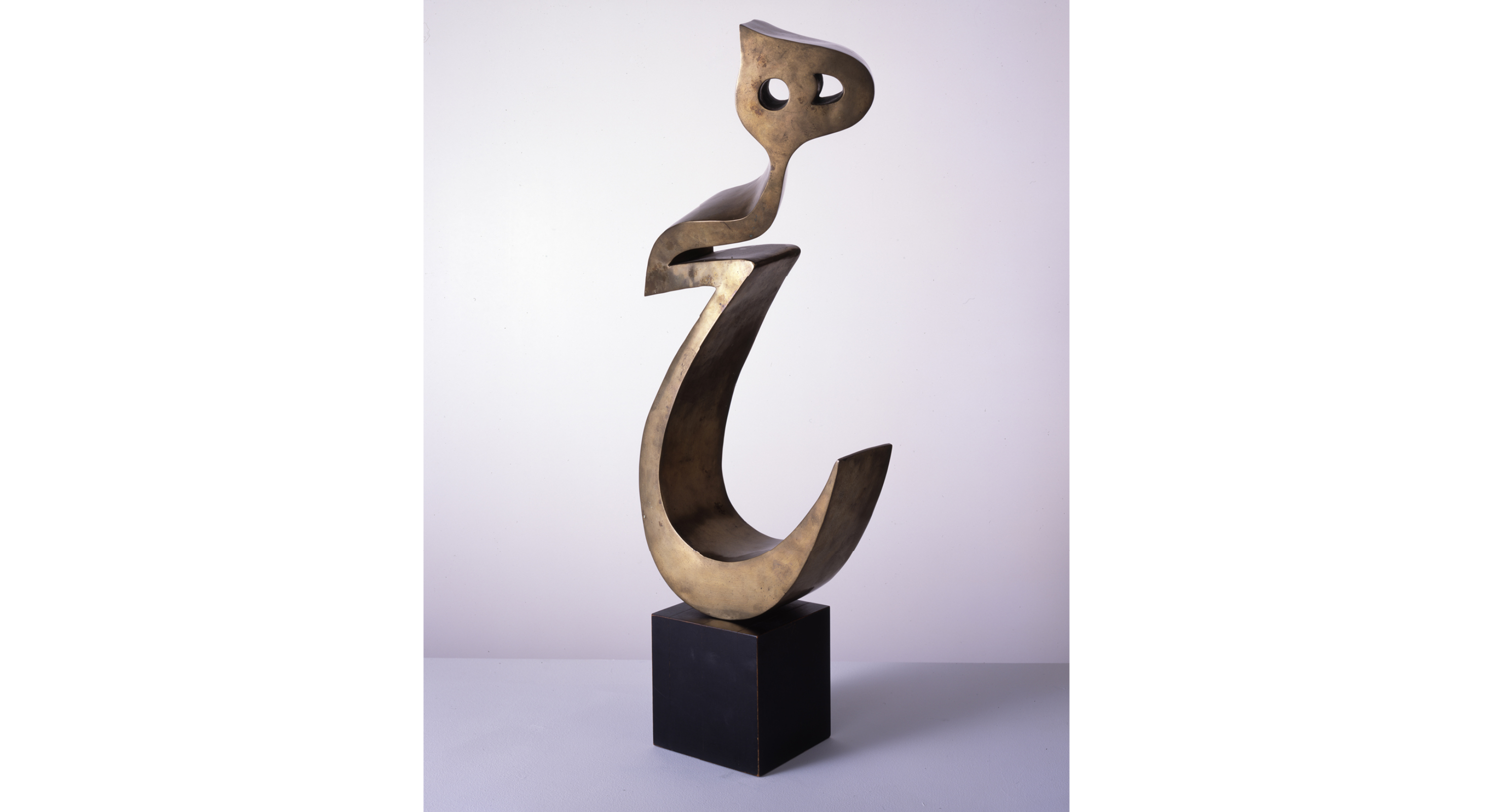
If you tell a Western product designer to “design Nothingness,” they will likely give you a blank screen. They interpret “Nothing” as the absence of data. But if you ask a Persian artist, they will build you a 500-pound bronze sculpture. This apparent paradox is best captured by the work of Parviz Tanavoli, Iran’s most celebrated modern sculptor. He is famous for a single, obsessive subject: the word Hich (Nothing).

Tanavoli renders the Persian script for “Nothing” in heavy, industrial bronze. He twists it, stacks it, and neon-lights it. To the casual observer, it’s just pop art. To the Systems Engineer, it is a masterclass in Negative Space.
Tanavoli is demonstrating that “Nothingness” is not a passive void; it is an Active Container. In design terms, the “content” of the sculpture isn’t the bronze; it is the empty space around the curves. The bronze is just the delimiter.
Why Statelessness Works
To understand why we need to engineer our internal lives this way, we have to look at the most perfect piece of “hardware” in existence: The Mirror (Aineh).
In Persian mysticism (Sufism), the ultimate goal of the human heart is to become a Mirror. Why? Because a Mirror is the only object in the universe that is truly Stateless.
Think about the physics of it. A mirror provides a perfect, High-Fidelity, Zero-Latency rendering of reality. It can do this for one specific reason: It has no memory. If a mirror “held onto” the image of the person who looked at it five minutes ago (Caching), it would be useless. It would layer the Past over the Present. It would cease to be a mirror and become a Painting (a static, stateful record).
We are obsessed with being Paintings — building a static, curated image of ourselves (“My Personal Brand”). But a Painting cannot process real-time data. Only a Mirror can. To process the world with absolute clarity, you must have the courage to retain nothing of the reflection once the object has moved on.
Revisiting the Hayat
This brings us back to the architecture we discussed in Part 1: The Hayat (The Central Courtyard). If you look at the floor plan of a traditional house in Yazd or Isfahan, you see a massive hole in the center.
In the West, we view empty space as inefficient. We maximize the Floor Area Ratio (FAR). We fill every square foot with “function” — a desk, a sofa, a server rack. We think innovation happens when we cram smart people into a crowded room (The Open Office Plan). But the Persian architect knows that Innovation requires an empty container. The Hayat is not “missing space”; it is the Processing Core.
- It is where the air circulates (Thermal Regulation).
- It is where the light enters (Vision).
- It is where the family gathers (Connection).
If you fill the courtyard with furniture, you kill the house. The system suffocates. Innovation dies.
Now, I want you to run a diagnostic on your own life. Look at your operating system through the lens of these two architectures, starting with your calendar.
Look at your Tuesday. Is it a game of “Calendar Tetris”? Have you stacked 30-minute Zoom blocks back-to-back, creating a solid wall of noise? This is Monolithic Scheduling. It feels efficient, but it’s actually a heat trap. There is no ventilation for the CPU. Now, imagine if you designed a Hayat into your day. I don’t mean a “lunch break” where you scroll Instagram; I mean a deliberate architectural void. Picture a 15-minute window of unallocated time where the only goal is air circulation. Remember: the courtyard isn’t “missing work”; it’s where the cooling happens.
Next, audit your mind. Is your brain running like a Chrome browser with 50 tabs open? Are you holding onto the “State” of an argument from three years ago and the “Predictive Model” of a recession three years from now? This is Stateful Hoarding. You are trying to process the present through a filter of cached data. instead, try to wipe the cache and become a Mirror. A mirror doesn’t try to “save” the reflection. It receives the light, renders it perfectly in zero-latency, and then lets it go the moment the object moves. It is powerful because it is empty.
We have spent our entire adult lives acting like medieval architects, building Fortresses to protect our “Stuff” — our titles, our assets, our egos. It is time to become Persian architects. It is time to stop designing the walls, and start designing the Void that protects our Sanity.
The Decentralized Operating Model. From Ego to Ecosystem.
We have established that the “Western Ego” is a Monolith — a single, massive server that tries to handle every request, stores every error log, and inevitably crashes under load.
So, what is the architectural alternative? If you talk to a modern Systems Architect, they will tell you that to fix a Monolith, you must break it down into Microservices. You move from a centralized hierarchy to a Decentralized Ecosystem.
In the Persian Operating System, this isn’t just a best practice for software; it is the blueprint for the soul. The goal is to move from a rigid “Identity” to a fluid “Network.”
The Physics of Fana aka Annihilation
In computing, a “Stateful” application remembers everything. It carries the “State” (history) of the user from one session to the next. This makes it heavy. A “Stateless” application treats every request as new. It is lightweight, fast, and infinitely scalable.
In our lives, we are obsessively Stateful.
- We carry the “State” of a trauma from 1999.
- We carry the “State” of a compliment from 2012.
- We are weighed down by the caching of our own history.
The Sufis developed a specific protocol to handle this called Fana (Annihilation). Westerners often mistranslate Fana as “Death.” It is not death. Fana is simply Going Stateless.
It is the deliberate decision to stop “saving” the session data of your ego. When you enter a state of Fana (or “Flow” in modern psychology), you are no longer “The Guy Who Won the Award Last Year.” You are just a processing node in the current moment. You have no history, and therefore, you have no latency.
Managing Technical Debt
But here is the glitch. Even if you want to be Stateless, there is a piece of legacy code running in the background that keeps trying to save the data.
The Sufis call this the Nafs (The Lower Self). The Engineer calls this Technical Debt.
Your Nafs is the spaghetti code written by your ancestors and your reptilian brain. It is the script that screams, “Hoard resources!” or “Get revenge!” or “Seek validation!” It is buggy, it is insecure, and it consumes massive amounts of CPU.
Rumi, the ultimate Senior Systems Architect, gives us two specific analogies to understand how this legacy code compromises the system.
Rumi often compares the Nafs to a donkey carrying a rider.
- The Rider (The Soul/Main Thread): Wants to go to the palace (Meaning or Purpose).
- The Donkey (The Nafs/Background Process): Wants to go to the stable (Food/Sex/Status).
“The intellect is the rider, and the nafs is the donkey. If you let go of the reins for one second, the donkey heads straight for the nearest patch of grass.”
This is a Resource Allocation Failure. You have a high-priority thread (Your Life’s Purpose) competing with a low-priority daemon (Your Ego’s Appetite). If you don’t apply “Quality of Service” (QoS) protocols, the low-priority daemon will hog 99% of the bandwidth downloading garbage data. Rumi isn’t saying “Kill the donkey” — you need the body to carry the code — he is saying Sandbox the Process. Do not give the donkey root access.
If the Donkey is annoying, the Dragon is fatal. Rumi tells the story of a snake catcher who finds a frozen dragon in the mountains. Thinking it is dead, he brings it to Baghdad to show it off to the crowds. But as the Iraq sun warms the dragon, it wakes up and devours him.
“Your Nafs is a dragon; do not think it dead. It is merely frozen by the lack of means.”
This is a Latent Security Vulnerability. We often think we have “fixed” our Ego because we are humble when we are broke or junior. But Rumi warns that the Nafs is simply a Sleeping Exploit. When you have no power, the exploit is dormant. When you get promoted, get funding, or get famous, you apply “Heat” to the system. This executes the malicious code.
We see this constantly in Silicon Valley. A founder is humble in the garage (Frozen Dragon). Then they raise Series B (Heat), and suddenly the “Dragon” wakes up, destroys the culture, and eats the company.
Most people try to “fight” their Nafs. But a Senior Engineer knows you don’t fight legacy code; you Containerize it. You treat the Nafs not as a monster, but as a deprecated library. You acknowledge it exists (“Ah, that’s the old ‘Insecurity v1.0’ script running again”), and then you route the traffic around it.
You keep the Dragon frozen by never feeding it the heat of arrogance.
A Licensing Issue
Finally, we have to talk about Intellectual Property. The biggest difference between the Western and Persian operating systems is the Licensing Model of the Ego.
The Western Ego is Proprietary Software. It is Closed Source. It is defensive. It says: “This is MY success. This is MY idea. This is MY brand.” It builds firewalls (NDAs, non-competes, emotional walls) to protect its source code. It views sharing as a loss of competitive advantage.
The Sufi Ego is Open Source. It is Contributive. It operates on a “Copyleft” license.
Rumi provides the technical documentation for this architecture in the opening lines of the Masnavi. He compares the human soul to a Reed Flute (Ney).
“Listen to the reed and the tale it tells, How it sings of separation…”
To the engineer, the Reed Flute is the ultimate Open Source hardware. Why does it make music? Because it is hollow. It has hollowed out its own “pith” (its internal substance, its Ego). Because it is empty, the breath of the musician can pass through it with zero resistance.
If the Reed insisted on being “Proprietary” — if it stuffed itself with its own wood shavings, saying “This is my space, I own this interior” — the air would block. Latency would hit infinity. There would be no sound.
Rumi is teaching us that Proprietary Egos are silent. They block the signal. The Open Source Ego is a Pipe. It doesn’t claim to “own” the wind; it simply offers itself as the runtime environment for the wind to pass through.
Forking the Repository (Radif) This explains why Persian music (The Radif) has survived for centuries without being written down. When a Persian master like Shajarian sings, he isn’t trying to “own” the melody. He is Forking the Repository.
- Clone: He pulls the code from the collective history (The Main Branch).
- Improvise: He adds his own ornamentation (Tahrir). This is Committing a Patch.
- Push: He releases the energy back into the room.
He knows that he is not the Server; he is just a Node. And as Hafez reminds us, the wine in the cup doesn’t belong to the cup — it belongs to the drunkards. The cup is just the interface.
Are you building a Proprietary Fortress to protect your “ideas”? Or are you hollowing yourself out like the Reed, so the signal can pass through you to the network? The former creates a “Personal Brand.” The latter creates Art.
Permissionless Innovation
This brings us to the ultimate benefit of the Decentralized Model: Permissionless Innovation.
In a Monolith (The Dictator/The Big Boss), you have to ask for permission to act. Innovation bottlenecks at the top. In a Decentralized Ecosystem (The Bazaar/The Network), no one needs permission.
- The musician doesn’t ask the conductor; they react to the audience.
- The architect doesn’t ask the city planner; they adapt to the light.
When you decentralize your own soul — when you stop running every decision through the “Root User” of the Ego — you unlock a terrifying amount of speed. You stop worrying about “How this looks” (Proprietary) and start focusing on “How this works” (Open Source).
Rumi captures this shift from “Node” to “Network” with his most famous hydraulic analogy: The Drop and the Ocean.
“You are not a drop in the ocean. You are the entire ocean, in a drop.”
As long as you identify as the “Drop” (The Proprietary Ego), you are limited by your own surface tension. You are fragile. You can evaporate. You have limited compute power. But the moment the Drop hits the Ocean (The Collective), it doesn’t “die” (Nihilism); it scales infinitely (Hich).
- The Drop: Local Processing. Limited RAM. High Latency.
- The Ocean: Distributed Cloud Computing. Infinite Storage. Zero Latency.
When you surrender the “Root User” status — when you let the drop fall — you suddenly inherit the physics of the entire ocean. You are no longer processing the wave; you are the wave. You have the processing power of the entire system behind you.
This is the ultimate efficiency hack. Why struggle to calculate the tide with your single-core CPU, when you can just be the tide?
The Upgrade Path
We have covered the theory. Now, let’s look at the specs.
If you were a CTO deciding whether to migrate your company’s entire backend from an on-premise mainframe to the cloud, you wouldn’t just go on “vibes.” You would ask for a side-by-side comparison. You would want to know: Why is the old system crashing? and Why is the new architecture worth the pain of migration?
The difference between Legacy Ego (The “Self”) and Hich (The Stateless “Void”) isn’t just a matter of philosophy. It is a fundamental difference in how they handle data, memory, and security.
The Memory Leak
The most critical flaw in the Legacy Ego is how it handles storage. The Western Ego treats Memory like a massive, spinning Hard Drive. It writes every error, every trauma, and every minor slight to the disk permanently. It creates “bad sectors” over time. You try to sleep at night, but the hard drive keeps spinning, indexing the embarrassment from 2003 and the breakup from 2018.
Khayyam offers a hardware swap. He suggests we treat Memory like RAM — volatile, fast, and temporary. In Khayyam’s architecture, the system is designed to be wiped. He looks at the “Record of the Past” not as a valuable database, but as a heavy load that slows down the processor. He teaches us that the only way to run the “Present Moment” at high fidelity is to flush the cache daily. As he famously noted, the Moving Finger writes, and having writ, moves on — not so you can read it, but so you can let it dry and fade.
The Security Flaw
But the most radical upgrade is in Security Protocols. The Ego runs on a “Castle Doctrine.” We spend 50% of our energy building Firewalls — layers of cynicism, irony, and defensiveness — to protect the “Soft Interior” of our self-esteem. We are terrified of being “hacked” by criticism or rejection.
Rumi proposes a security architecture that seems insane minds: Transparency.
He asks: Why do you fear the robber? You fear the robber because you are full of “Stuff” — your pride, your reputation, your hoard of identity. If you are a gold mine, you must build walls. But if you are Hich — if you are an empty room — the robber enters, looks around, finds nothing to steal, and leaves.
Rumi argues that the ultimate security isn’t a thicker wall; it is an empty house. You cannot break what does not exist. You cannot steal from a void. By becoming “Nothing,” you become Antifragile. You stop wasting your CPU cycles defending a perimeter that doesn’t need to be there, and for the first time in your life, you can leave the front door open.
Ontology as Technology
We tend to think of ontology — the study of being — as a dusty academic pursuit, something reserved for people wearing tweed jackets in the faculty lounge. But in my experience, the most aggressive ontologists aren’t professors; they are Private Equity investors.
I learned this from observing the methodology of Chris Freund, the founder of Mekong Capital. Chris doesn’t just look at balance sheets; he looks at the “Source Code” of the leadership. He treats ontology not as philosophy, but as Technology — a tool for generating exponential value.
His thesis is built on a distinction that is pure Persian mysticism wrapped in venture capital terminology: the difference between the World of the Past and the World of Possibility.
The “Past Performance” Trap
Every prospectus carries the same warning in bold print: “Past performance is not indicative of future results.” We accept this in finance, yet we violently reject it in our own lives.
Most of us are heavily invested in the World of the Past. We treat our identity like a legacy portfolio. We look at our “Historical Data” — our degrees, our previous titles, our traumas, our wins — and we project them forward linearly. We say, “I am a Project Manager because I managed projects yesterday.”
This is a safe, low-yield investment strategy. It might get you 5% year-over-year growth. It is the “Treasury Bond” of existence — secure, but stagnant.
But to build a Unicorn — to achieve the kind of non-linear breakthrough that defines a great company or a great life — you cannot invest in what you already know. You have to invest in the Unknown.
Shorting the Ego, Longing the Void
This is where the “Chris Freund” method aligns perfectly with Rumi. To create a breakthrough, you have to leave the World of the Past (Statefulness) and stand firmly in the World of Possibility (Statelessness).
The World of Possibility is terrifying because it is empty. It has no data. It is, by definition, a Void. But Rumi, the ultimate Venture Capitalist of the soul, reminds us that the Void is where the money is.
“The workshop of God is in Non-Existence. You are looking for the work in the showroom, but the value is created in the Factory of the Void.”
When you stand in the “Void” (Hich), you are no longer constrained by the trend lines of your history. You are no longer “The guy who failed his startup in 2019.” You are a blank check. You represent pure potentiality. This is why the “Empty Center” we discussed earlier is so valuable. Innovation doesn’t happen in the warehouse (Memory); it happens in the R&D Lab (Possibility). And the R&D Lab must be kept clean.
The Asset Class of Bewilderment
Rumi has a specific piece of investment advice for this stage:
“Sell your cleverness and buy bewilderment.”
“Cleverness” is your proprietary data — your ego, your strategies, your knowns. It is a depreciating asset. “Bewilderment” is the state of not knowing. It is the Void. It is an appreciating asset because it is the only state that allows for discovery.
If you are “Clever,” you already know the answer. The market is efficient; the opportunity is gone. If you are “Bewildered,” you are observing the market in real-time, zero-latency, ready to catch the wave that no one else sees.
Anti-Fragility
Finally, let’s talk about Risk Management. Why is Hich the safest investment? Because it is Anti-Fragile.
In the World of the Past, you are a “Something” — a Statue. Statues can be toppled. Reputations can be ruined. Egos can be bruised. You are constantly paying “Insurance Premiums” (Defensiveness) to protect this asset.
But you cannot break a Void. You cannot bankrupt a Zero. When you operate from Hich, you have zero downside protection costs because you have nothing to defend. You become Transparent Security. The market volatility (life’s chaos) passes right through you like wind through the Reed Flute.
So, the investment thesis is simple: Short the Story. Long the Silence. Stop reinvesting dividends in the “Story of Me.” Take the capital out of the Past and pour it all into the Empty Space of what is possible right now. The returns are infinite.
Designing the Empty Container
We have reached the final commit of our full-stack debugging session. Over this trilogy, we didn’t just analyze culture; we attempted a system restore on the modern human experience.
We began at the physical layer, learning from Persian Music that our hardware — the nervous system — needs the geometric sanity of the Radif to down regulate the noise. We moved to the temporal layer, discovering in The Algorithm of Deep Time that true efficiency isn’t about speed, but about “Texture” — building a Badgir (Windcatcher) to cool the passing moment.
And now, we stand at the kernel: The Void.
This is the hardest patch to install because it contradicts every line of code we’ve been taught in the West. We are conditioned to be “Architects of More.” We stack achievements like bricks, building a heavy Fortress of Identity to prove we exist. We think that if we stop building, we will disappear.
But the Persian master architect knows the truth: The utility of the cup is not the clay; it is the space within.
Rumi opens his magnum opus not with a shout, but with a sound that requires emptiness: the wail of the Ney (the Reed Flute). He asks us to look at this instrument. Why does it enchant the world? It is not because of its decoration. It is not because of its gold plating. It makes music for one simple reason: It has been hollowed out.
The reed was once full of “pith” — its own pulp, its own substance, its own “Ego.” As long as it was full of itself, it was silent. It was just a stick in the mud. Only when it allowed itself to be emptied — when it accepted the architecture of Hich — did it become capable of turning breath into music.
This is your final design spec. You have spent decades filling yourself with “pith” — your titles, your anxieties, your proprietary stories. It is time to clear the blockage. Do not fear the Nothingness. The Nothingness is not a void of silence; it is a channel for the signal.
When you finally stop trying to be the “Composer” of your life (The Monolith) and accept your role as the “Instrument” (The Open Source Flute), you unlock a terrifying, beautiful capacity. You become a superconductor for the present moment.
So, let the fortress fall. Let the hard drive wipe. Stand in the center of your own life, not as a heavy statue of who you used to be, but as a hollow reed waiting for the breath. That is the only way to play the song. And trust me — the music is worth it.