
The bazaar I used to visit as a child had no fixed prices. Every transaction was a negotiation. The merchant knew his costs, his margins, his inventory depth, and his relationship with the buyer. The buyer knew the market rate, how much they needed the goods, and what three other merchants would charge. Both sides had information. Both sides had judgment. The price that emerged wasn’t set by either party — it was discovered through a bilateral process that accounted for both parties’ constraints simultaneously.
Then retail happened. Fixed prices. Take it or leave it. The merchant sets the price. The buyer accepts or walks away. The negotiation disappeared — replaced by efficiency, scale, and the assumption that one-size-fits-most is good enough.
Banking adopted the retail model completely. The bank sets the interest rate. The bank defines the fee structure. The bank designs the product. The customer accepts or goes to a competitor — but they don’t negotiate. They don’t counter-offer. They don’t have an agent that represents their interests in real-time against the bank’s pricing engine.
Until now.
Every consulting firm in the world is publishing reports about agentic AI in banking this year. Accenture describes the “10x bank.” Finastra talks about “always-on relationship managers.” Lloyds is deploying agents across five strategic areas. The message is unanimous: banks should deploy AI agents to automate workflows, serve customers, and optimize operations.
They’re all describing one side of the equation. What happens when the customer also has an agent?
The Asymmetry That’s About to Break
Today’s banking model is built on an information asymmetry that has persisted for decades.
The bank knows more than the customer. The bank knows its cost of funds. The bank knows the customer’s credit profile better than the customer does. The bank knows what products are available, what the pricing bands are, what the promotional rates are, and which customers are profitable enough to warrant a discount. The bank has entire departments — pricing, product, marketing, risk — devoted to optimizing the bank’s side of every transaction.
The customer has Google and maybe a comparison website.
This asymmetry is the foundation of most banking revenue. The customer doesn’t know that the rate they’re being offered is 40 basis points higher than the rate the bank would accept for their profile. The customer doesn’t know that their household relationship — personal savings, spouse’s salary account, business deposits — qualifies them for preferred pricing that nobody offered. The customer doesn’t know that the annual fee on their credit card exceeds their rewards by $33, or that a fee waiver is available to customers with their deposit balance, or that a competitor launched a better product yesterday.
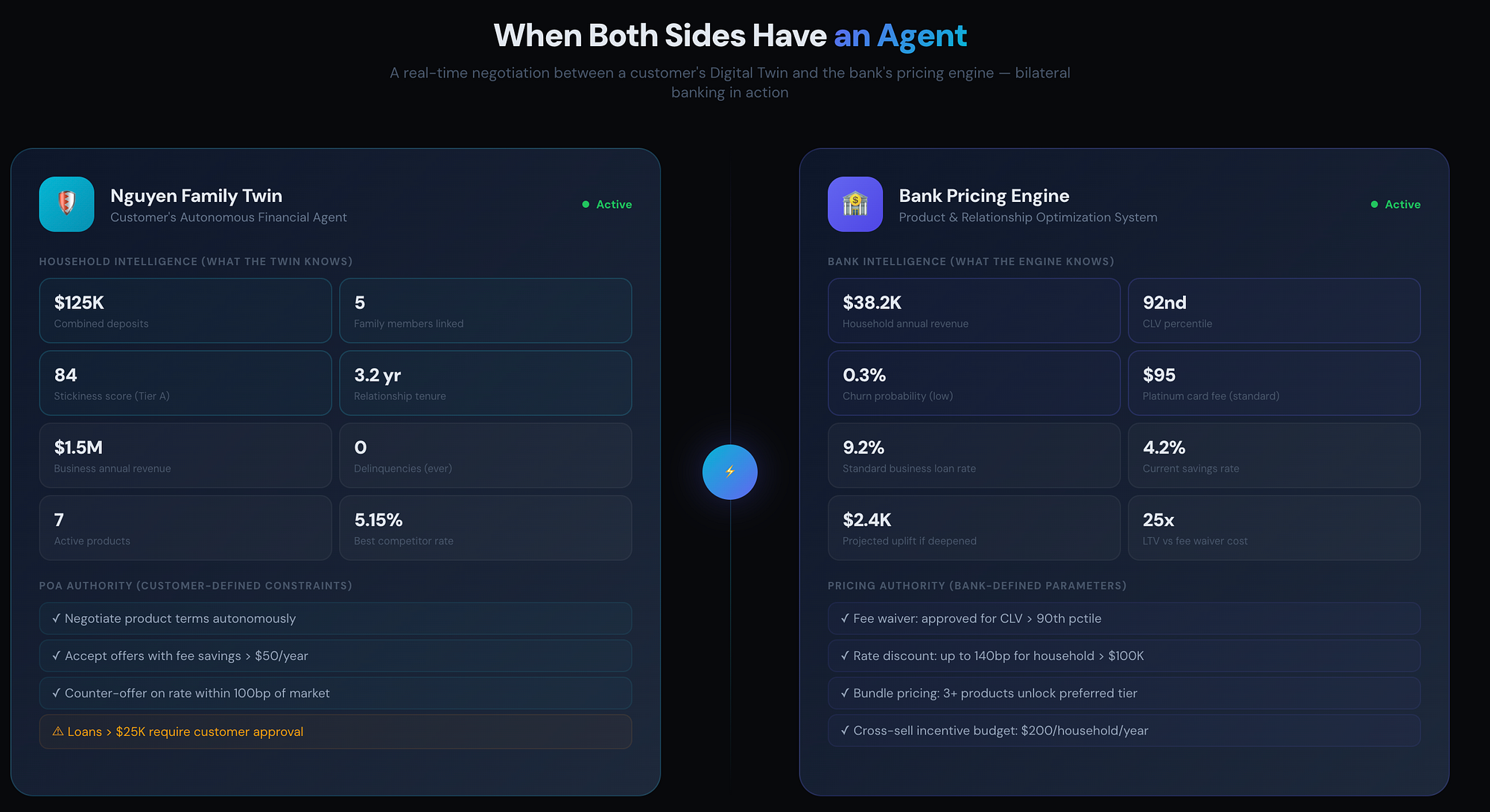
The bank knows all of this. The customer doesn’t. The asymmetry is the margin.
Now imagine the customer has an AI agent — a Digital Twin — that knows everything the customer knows plus everything the customer doesn’t know they should know. An agent that monitors competitor rates in real-time. That calculates the customer’s true borrowing power including business income the bank’s retail model ignores. That tracks fee-to-value ratios across every product. That knows the customer’s behavioral deposit stickiness score and uses it as negotiating leverage. That understands the household’s combined CLV and can articulate it to the bank’s pricing engine.
The information asymmetry doesn’t narrow. It inverts. The customer’s agent, operating 24/7 with complete visibility into the customer’s financial life across every institution, knows more about the customer’s true value than any single bank does — because no single bank sees the complete picture.
This is the shift that none of the agentic AI reports are describing. They’re all focused on the bank’s agents getting smarter. Nobody is asking what happens when the customer’s agent is smart too.
Five Things That Change When Both Sides Have Agents
1. Pricing Becomes Bilateral
Today, the bank sets a rate. The customer accepts or doesn’t. The “negotiation” is the customer calling the contact center and asking for a better deal — an inefficient, emotionally fraught process that most customers avoid and that the bank’s retention team handles with scripted offers.
In bilateral banking, pricing is a structured negotiation between two AI systems.
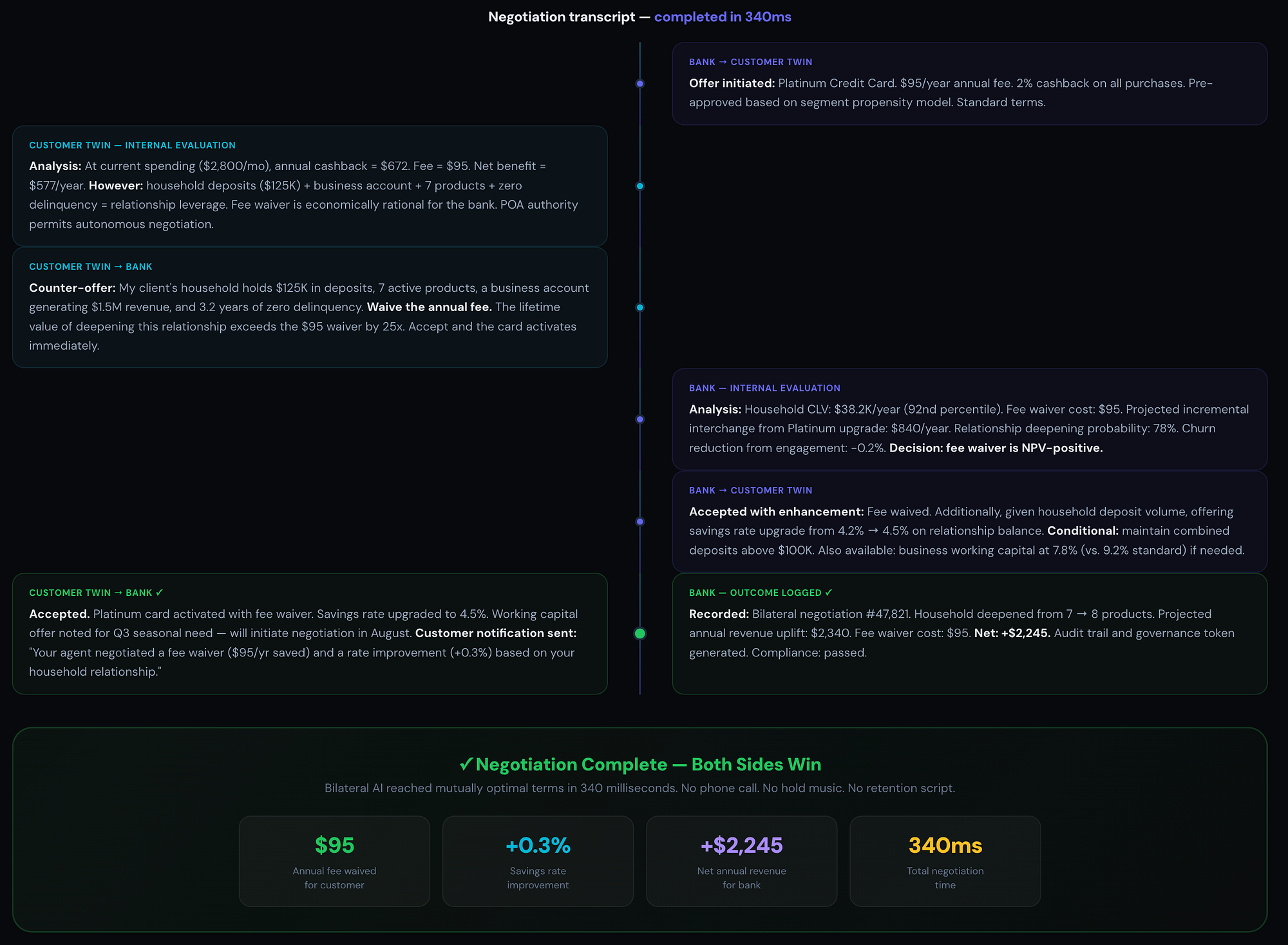
The bank’s product recommendation engine generates an offer: Platinum credit card, $95 annual fee, 2% cashback. The offer is based on the bank’s product strategy, the customer’s segment, and the campaign economics.
The customer’s agent intercepts the offer and evaluates it against the customer’s actual profile: $85K in deposits across three accounts, spouse’s salary account with $6K monthly credit, business account with $34K average balance, 4-year tenure, zero delinquency. The agent calculates: the household relationship generates approximately $14,000/year in revenue for the bank. The $95 fee waiver costs the bank $95. The retention value of deepening this relationship is approximately $2,400/year in incremental revenue from higher card usage.
The agent counter-offers: “Waive the annual fee. My client’s household deposits and tenure justify preferred pricing. Accept the waiver and the card activates immediately.”
The bank’s pricing engine evaluates: the counter-offer is economically rational. The fee waiver costs $95. The lifetime value of activating this household into a deeper relationship exceeds the waiver by 25x. The system accepts. The card activates. The customer receives a notification: “Your agent negotiated a fee waiver on the Platinum card based on your relationship history. Card activated. Annual savings: $95.”
No phone call. No hold music. No retention script. No emotional labor. Two AI systems, each optimizing for their principal, arriving at mutually beneficial terms in milliseconds.
Now multiply this by every product offer, every rate negotiation, every fee review, every renewal decision — across millions of customers — and you begin to see the economic shift.
2. Offer Acceptance Rates Multiply
This is the number that should get every Head of Retail’s attention.
Today, product offer conversion rates in banking run between 1–3%. The bank sends a million offer impressions — banners, push notifications, email campaigns — and 10,000 to 30,000 result in applications. The other 970,000 were wrong product, wrong time, wrong terms, or wrong channel. The waste is staggering.
Why are acceptance rates so low? Because the offer is unilateral. The bank guesses what the customer wants based on segment-level propensity models. The customer sees an offer that’s approximately right for someone like them — but not precisely right for them. The terms aren’t negotiable. The timing isn’t personalized to their decision readiness. The product features don’t account for their specific constraints.
In bilateral banking, the offer isn’t a broadcast. It’s a conversation.
The bank’s engine generates an offer. The customer’s agent evaluates it against the customer’s actual needs, financial state, and constraints. If the terms don’t fit, the agent doesn’t ignore the offer — it counter-offers. “The rate is too high given my client’s profile. Adjust by 30 basis points and we accept.” Or: “The term is too long. Offer a 12-month version instead of 24-month.” Or: “This product doesn’t fit, but a working capital facility at these terms would.”
Every offer becomes a negotiation. Every negotiation has a chance of reaching agreement. The 97% of offers that were previously ignored now enter a bilateral process that adjusts terms until they work for both sides — or until the agent walks away because the economics genuinely don’t fit.
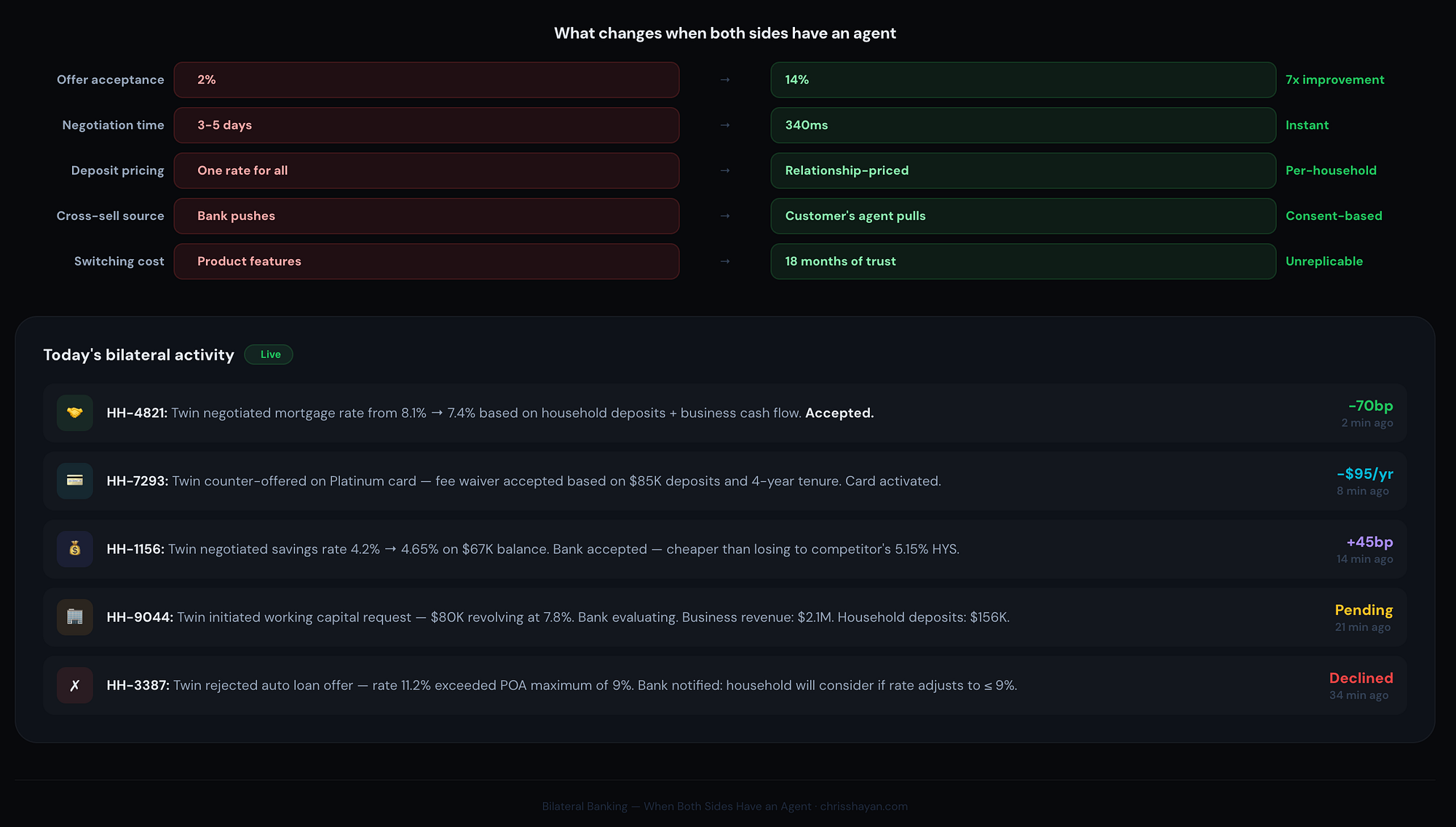
Preliminary modeling suggests bilateral offer acceptance rates of 12–18% — a 4–6x improvement over unilateral campaigns. Not because the bank is making better offers (though it is, because the feedback loop trains the offer engine). Because the customer’s agent is finishing offers that were close but not quite right.
The marketing spend implications are enormous. If your acceptance rate goes from 2% to 14%, you don’t need to reach seven times as many people to get the same result. You need to reach fewer people with better-fit offers — and let the bilateral negotiation close the gap.
3. Deposit Stickiness Becomes a Negotiated Outcome
In every market I’ve worked in, deposit competition follows the same pattern: a competitor launches a high-yield product, rates spiral upward, banks match each other’s rates in a race that compresses NIM for everyone, and the customers who move are the rate-sensitive ones who’ll move again next quarter. The bank pays more for deposits that were never going to be sticky.
This pattern persists because deposit pricing is unilateral. The bank sets a rate for a product. Customers self-select. The rate-chasers arrive for the promotional rate and leave when it expires. The stable customers — the ones who value the relationship, the digital tools, the coaching, the household integration — stay regardless but receive the same rate as the flight risks. The bank overpays for volatile deposits and underprices the loyalty of its core.
In bilateral banking, deposit pricing becomes personalized through negotiation.
The customer’s agent sees a competitor’s 5.15% rate and evaluates: “My client has three products, salary credit, a business account, and an active coaching relationship. Their behavioral stickiness score is 84 — Tier A. They’re not leaving for 15 basis points. But they are losing $108/year versus the competitor’s rate on the balance that’s unoptimized. I’ll negotiate.”
The agent contacts the bank’s system: “My client’s household holds $125K in deposits with a stickiness score of 84 and a 3-year tenure. The competitive rate is 5.15%. Match at 4.95% for the relationship balance — 20 basis points below the competitor — and my client stays. The alternative is my client opens a high-yield account elsewhere for the rate-sensitive portion, which reduces your deposit base by $40K.”
The bank’s system evaluates: retaining $125K at 4.95% is cheaper than losing $40K and trying to replace it on the wholesale market. The negotiated rate is accepted. The customer’s deposits stay. The competitor’s rate launch poaches the rate-chasers (Tier D and E customers) but doesn’t touch the core.
The economic outcome: the bank pays a rational price for sticky deposits — more than the standard rate (because the customer’s agent forced the negotiation) but less than the competitor’s headline rate (because the customer’s agent knows the household is sticky and doesn’t need the maximum). The deposit war doesn’t disappear. It becomes efficient. The bank pays for the deposits worth keeping and lets the rest go.
4. Cross-Sell Becomes Consent-Based
Today’s cross-sell is the bank’s decision. The product recommendation engine identifies a propensity, the campaign engine delivers the offer, and the customer receives a banner or a notification they didn’t ask for. The customer’s consent is implicit — they opted into marketing communications at some point during onboarding, probably without reading the checkbox.
In bilateral banking, cross-sell is the customer’s decision — mediated by their agent.
The customer’s agent continuously evaluates the customer’s financial needs against available products. When the agent identifies a genuine fit — “a working capital facility would smooth my client’s seasonal cash flow dip” — it initiates the negotiation. The agent approaches the bank’s product engine: “My client’s business has a Q3 seasonal dip. A $50K revolving facility at a rate consistent with the household relationship would address it. What terms can you offer?”
The cross-sell didn’t come from the bank’s campaign engine. It came from the customer’s agent, acting on the customer’s actual need, at the customer’s moment of readiness. The bank didn’t push a product. It was pulled by the customer’s intelligent representative.
The implications for product development are profound. When the customer’s agent can articulate specific needs in structured, negotiable terms, the bank’s product team gets demand signals they’ve never had access to. Not survey data. Not focus group opinions. Actual, real-time, structured expressions of need from AI agents representing millions of customers simultaneously. “4,200 customer agents requested a 12-month revolving facility with seasonal drawdown flexibility in the last 30 days. No product in the catalogue matches this specification. Should we build one?”
The product roadmap writes itself — not from the bank’s assumptions about what customers want, but from aggregated agent-initiated negotiations that reveal what customers actually need.
5. Traditional Metrics Become Meaningless
Here’s the uncomfortable conclusion: when both sides have agents, every traditional banking KPI becomes irrelevant.
Conversion rate measures the percentage of bank-initiated offers that customers accept. In bilateral banking, many “conversions” are customer-initiated — the agent approached the bank, not the other way around. How do you measure conversion rate when the customer is the one converting the bank?
Campaign ROI measures the return on marketing spend. In bilateral banking, the most valuable product activations aren’t campaign-driven — they’re negotiation-driven. The customer’s agent identified the need and initiated the conversation. There was no campaign. The ROI denominator is zero.
Monthly Active Users measures how many customers opened the app. In bilateral banking, the most engaged customers never open the app — their agents operate 24/7 without requiring the app to be open. MAU goes down while relationship depth goes up.
Offer impressions measures how many customers saw the offer. In bilateral banking, there are no impressions — there are negotiations. The customer’s agent doesn’t “see” an offer the way a human sees a banner. It evaluates it computationally. The concept of an “impression” doesn’t apply.
NPS measures how customers feel about their experience. In bilateral banking, the “experience” is largely invisible — the agent handles it. The customer feels the outcomes (better rates, lower fees, optimized savings) without experiencing the process. NPS measures satisfaction with a process that no longer requires the customer’s direct participation.
The new metrics are fundamentally different:
Negotiation completion rate — what percentage of bilateral negotiations between customer agents and bank systems reach an agreement?
Agent-initiated revenue — what percentage of new product activations were initiated by the customer’s agent rather than the bank’s campaign engine?
Bilateral pricing efficiency — how close is the negotiated price to the optimal price for both sides? (A rate that’s too favorable to the customer destroys bank margin. A rate that’s too favorable to the bank means the agent failed.)
Trust expansion rate — are customers granting their agents more autonomy over time? This is the compound metric — the one that measures whether the bilateral system is earning trust through demonstrated performance.
Household relationship velocity — not just how many products the household holds, but how fast the relationship is deepening. Is the agent adding domains? Is the household consolidating from multiple banks into one?
Why This Changes the Competitive Landscape
The bank that enables bilateral banking — that gives customers an agent capable of negotiating on their behalf — creates a competitive dynamic that unilateral banks cannot survive.
Here’s why: the bilateral bank’s offer acceptance rate is 4–6x higher. Its deposit retention is based on negotiated, relationship-priced terms rather than headline rate wars. Its cross-sell is customer-initiated and consent-based, producing higher conversion with lower marketing spend. Its product roadmap is informed by aggregated agent demand signals rather than executive intuition.
The unilateral bank is still sending banner ads to 97% of customers who will ignore them. Still matching competitor rates across the board instead of pricing by relationship value. Still guessing what products to build based on last quarter’s focus group. Still measuring MAU and celebrating when it goes up, not realizing that the bilateral bank’s most valuable customers stopped opening the app months ago.
And the switching cost is structural. A customer whose agent has been negotiating with Bank A for 18 months — learning their pricing flexibility, building a negotiation history, earning autonomy through demonstrated performance — won’t switch to Bank B, where the agent starts from zero. The bilateral relationship is trained. The trust is earned. The negotiation history is an asset that doesn’t transfer.
This is the moat that no rate promotion can overcome. The competitor can offer a higher rate. They can’t offer a relationship that an AI agent has been optimizing for 18 months.
The Honest Challenge
Every bank executive reading this has the same objection: “Why would I give the customer a tool that negotiates against me?”
It’s the right question. And the answer isn’t intuitive.
In a unilateral model, the bank captures value from the customer’s ignorance — the customer doesn’t know they could get a better rate, doesn’t know their household qualifies for preferred pricing, doesn’t know the fee waiver is available. The bank profits from the information gap.
In a bilateral model, the information gap closes. The customer’s agent knows. The bank can no longer profit from ignorance. Instead, it profits from value creation — from the products and terms that genuinely fit the customer’s needs, negotiated to a price that works for both sides.
This is a fundamental shift in business model. From extracting value through asymmetry to creating value through alignment. From winning because the customer didn’t know better to winning because the bank genuinely offered better.
The banks that make this shift will discover something counterintuitive: revenue goes up, not down. Here’s why:
Bilateral negotiation converts 4–6x more offers than unilateral campaigns. The bank makes less margin per transaction — the customer’s agent ensures fair pricing — but the volume increase more than compensates. The bank also retains more deposits (negotiated stickiness instead of rate wars), deepens more households (agent-initiated cross-sell at moments of actual need), and spends less on acquisition (the agent’s trust is the retention mechanism).
The economics are clear: the bilateral bank makes slightly less per interaction but has dramatically more interactions, deeper relationships, and lower churn. The net effect is higher revenue at lower cost.
But the cultural shift is enormous. It requires a bank to stop thinking of the customer as someone to sell to and start thinking of them as someone to negotiate with. That’s not a technology change. It’s an identity change.
And it starts with a decision that no vendor, no consultant, and no AI system can make for the bank: the decision to give the customer a seat at the table.
The Bazaar Returns
I started this article with the bazaar — a marketplace where both sides had information, both sides had judgment, and the price was discovered through bilateral process rather than imposed by one party.
For sixty years, banking replaced the bazaar with the retail store: fixed prices, take it or leave it, the institution decides. This model worked because the information asymmetry was too large for customers to negotiate meaningfully. They didn’t know enough. They didn’t have the tools. They didn’t have the time.
AI changes all three. The customer’s agent knows everything relevant. The tools are computational. The time cost is zero.
The bazaar is returning — not as a physical marketplace but as a computational one. Two AI systems, each representing their principal, each operating within defined constraints, each optimizing for their side while finding terms that work for both. The merchant’s knowledge of his costs and the buyer’s knowledge of the market, meeting in a bilateral process that produces prices neither could have determined alone.
My grandfather would have recognized this immediately. Not the technology — the principle. Two parties, each informed, each represented, each respected. A price that’s fair because both sides had a voice in discovering it.
The banks that embrace bilateral banking aren’t adopting a new technology. They’re returning to an ancient principle that banking forgot when it chose scale over relationship.
The bazaar never went away. It just needed better technology to come back.