Every bank I have worked inside has had the same conversation, repeated quarterly, in slightly different rooms. How productive is our engineering organisation? What skills do we actually have? Where are the gaps? The answers come back as decks. The decks are built by people who copy numbers from Jira into Excel, add some charts, write an executive summary that smooths the edges, and present a version of reality that everyone in the room knows is approximately true and approximately not.
This is not a failure of effort. It is a failure of architecture. The data exists — in Jira, in LinearB, in Pluralsight, in GitLab, in the HR system. The layer that turns it into a single operating view does not. So the quarterly conversation stays what it has always been: a performance of governance rather than governance itself.
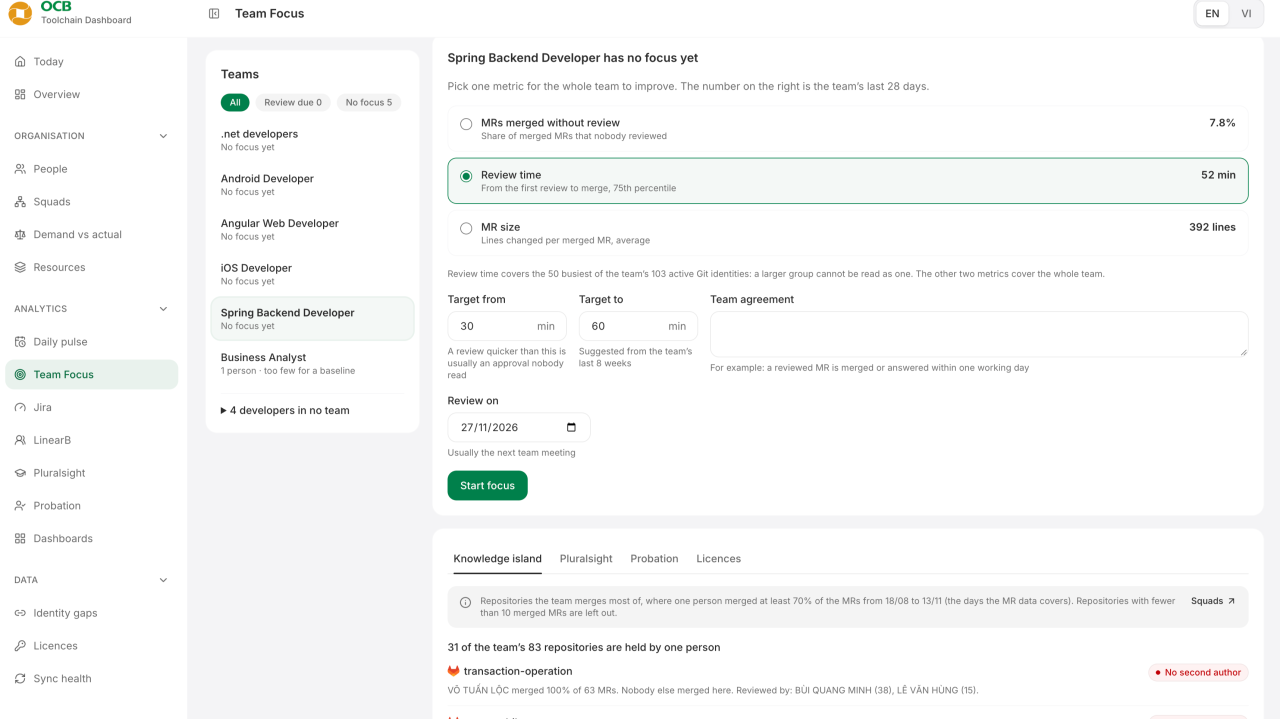
At OCB we have been building that missing layer. We call it the Toolchain Dashboard, and it is already answering questions I have spent fifteen years watching banks fail to answer.
Three surfaces carry most of the weight.
Knowledge — what we actually know. Pluralsight tells us which engineers have taken which skill assessments, which channels they have completed, which topics they rank Expert in and which they rank Novice in. We can see, at any moment, how many Spring Backend Developers in the organization are Expert level, how many are behind, who dropped from Expert to Average after the last retake. This is not a training report. It is a live map of what our engineering organization actually knows, by role, by squad, by individual.
Practice — how that knowledge shows up in real work. LinearB tells us what the knowledge is doing. Coding time, pickup time, review time, deploy time — the four stages of engineering flow, measured against the 2026 industry reference benchmark at p75. We can see which squads ship in 17 days and which take 28. We can see where in the pipeline each squad is losing time. We can see when a squad with high review depth also has low rework, which is the signature of a team that is genuinely learning.
Productivity — what the day actually looks like. Daily Pulse is the surface I am proudest of. Three times a day — start of day, after stand-up, end of day — the system captures a view of what every engineer in the organisation is doing. Who moved yesterday and who has nothing to start today. Who finished a ticket and is ready for the next task. Who has had no work for the last six hours. The system flags the people who need attention, in a way that gives their lead the information to help them without surveillance for its own sake.
Behind all three sits the same architecture: AI reading the toolchain, data flowing through the same pipeline, governance expressed as code rather than as opinion.
The tool was built by a small team of engineers I am genuinely proud of. Lê Đức , Nguyen Nguyen Viet and Loc Vo led the hardest parts — the Daily Pulse engine, the Pluralsight integration, the LinearB benchmark layer — and shipped working production code at a pace I have not seen outside of elite startups. What they have demonstrated is a simple point I keep returning to: when you give talented engineers the right AI tools and get out of their way, the velocity is not incremental. It is a different category of thing entirely.
The question I am sitting with now is what happens when every bank runs its engineering organization this way by default — and how much of a lead the ones who start now will have earned by the time the rest catch up.
We are three months in. The first answers are already clear enough to act on.