An octopus has about 500 million neurons. Roughly two thirds of them are not in its head. They sit in its arms. Peter Godfrey-Smith, in Other Minds, describes an animal whose arms can taste, explore and make small decisions on their own, while the central brain sets direction. Each arm has some intelligence of its own. The animal is still one animal.
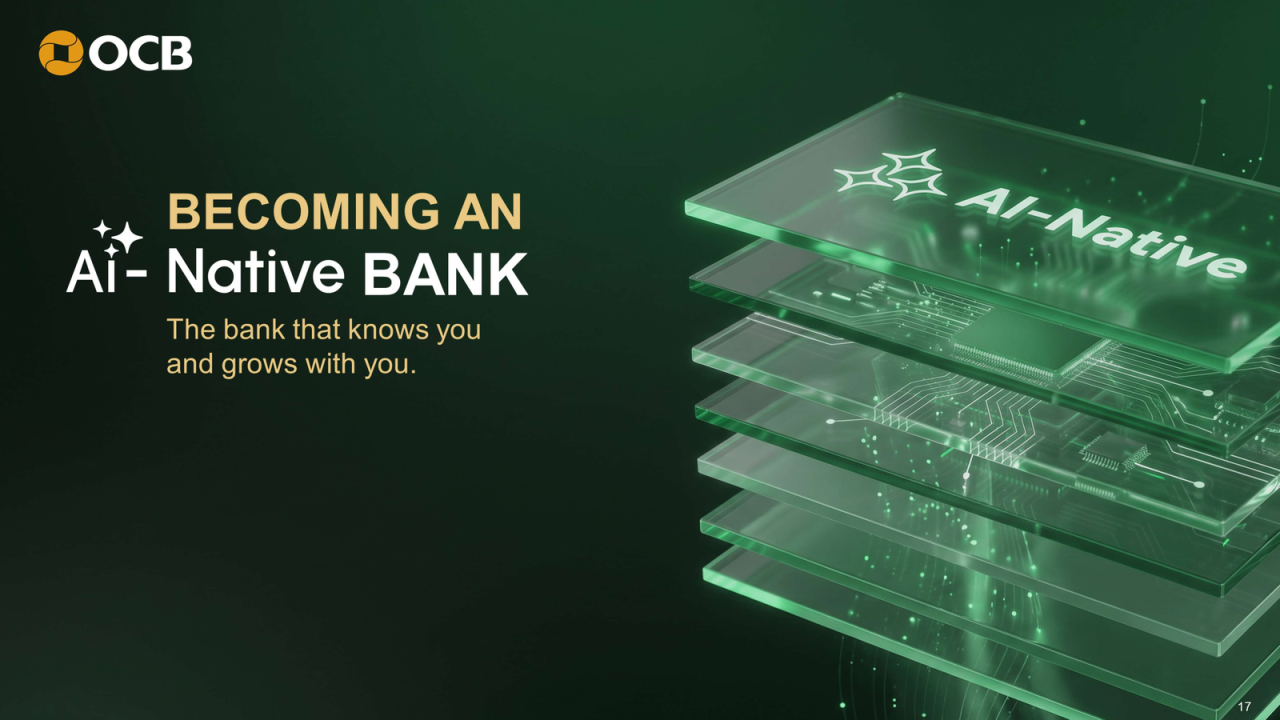
I have been thinking about that octopus all quarter, because it is the clearest picture I have of what we mean at OCB when we say “AI-native bank.” Most banks build AI the other way round: one clever central team, a queue of requests, a handful of showcase projects. The brain does the work and the arms wait.
On our 3Q26 earnings call, I will walk through the section of our results presentation on digital transformation and AI. I want to write it down here too, with a little more room than a slide allows, because the numbers tell a story that is more interesting than any single number in them.
From assistants to infrastructure
Our AI and data strategy has three pillars. I will describe them plainly, because none of them is exotic.
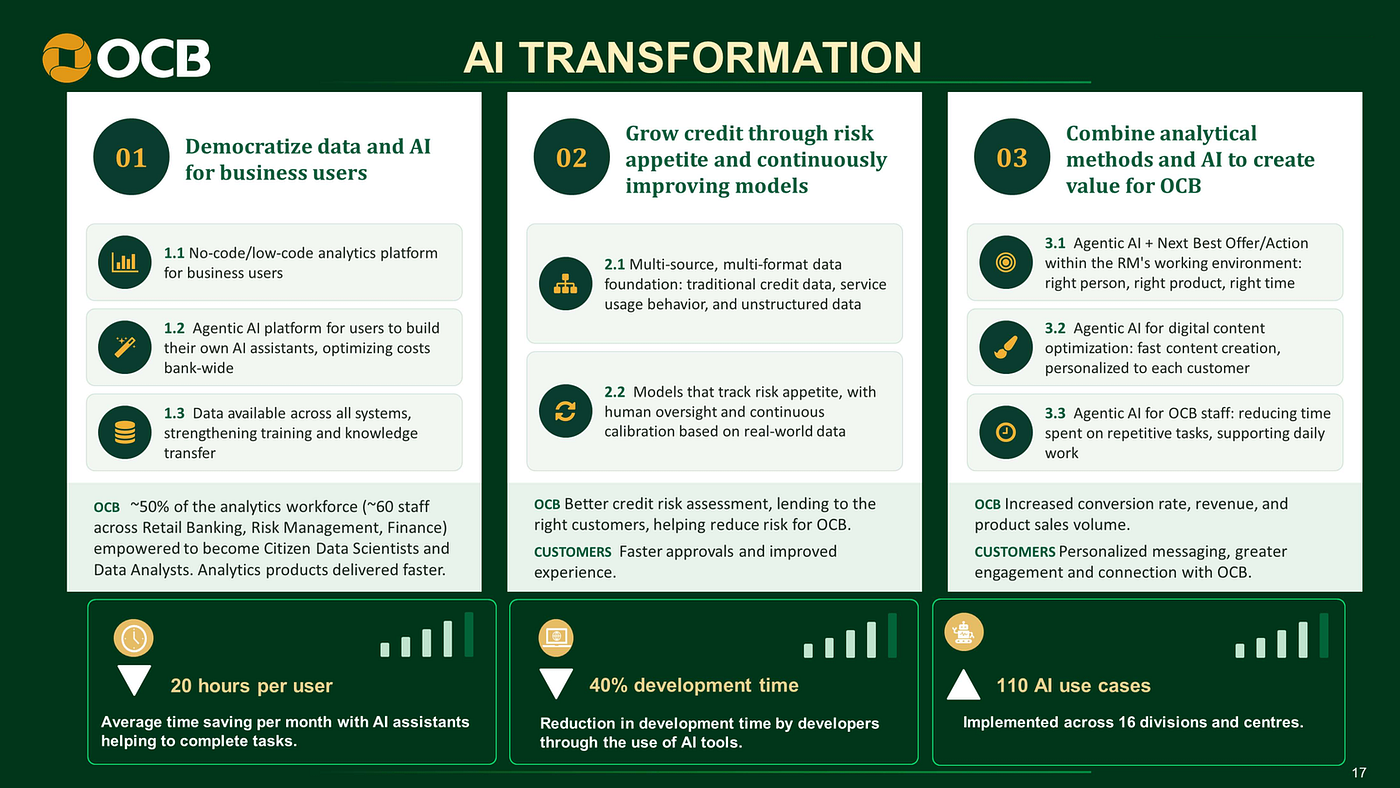
First, put data and AI in the hands of the people who understand the business. That means a no-code and low-code analytics platform, so a product manager in Retail does not need to file a ticket and wait two weeks to find out why card activation dipped in one province. It means an agentic AI platform where every staff member can build their own assistant. And it means making data available across systems, then training people until they are confident using it. Tools that nobody trusts do not create value.
Our target is that around half of the analytics workforce, about 60 people across Retail Banking, Risk Management and Finance, work as citizen data scientists and analysts inside their own business units. That is the octopus. Intelligence in the arms.
Second, grow credit within our risk appetite, with models that keep learning. We have studied how leading AI-first lenders in China built their credit engines, and the lesson is not about algorithms. It is about the data foundation underneath them. So we are combining traditional credit data with service-usage behaviour and unstructured data, and building models that track our risk appetite, with humans in the loop and continuous recalibration against what actually happens. For the bank, that means lending to the right customers. For customers, it means faster approvals.
Third, combine analytical methods with AI rather than replacing one with the other. Agentic AI paired with Next Best Offer and Next Best Action models, delivered straight into the relationship manager’s working screen: the right person, the right product, the right time. Agentic AI for content, so the message a customer sees is written for them and not for a segment of two million. And agentic AI for our own people, querying and exporting data so a business user can answer their own question in minutes instead of raising a ticket.
A pilot impresses a committee. A platform changes a Tuesday.
From individual assistants to enterprise-wide automation. Here is where we are today:
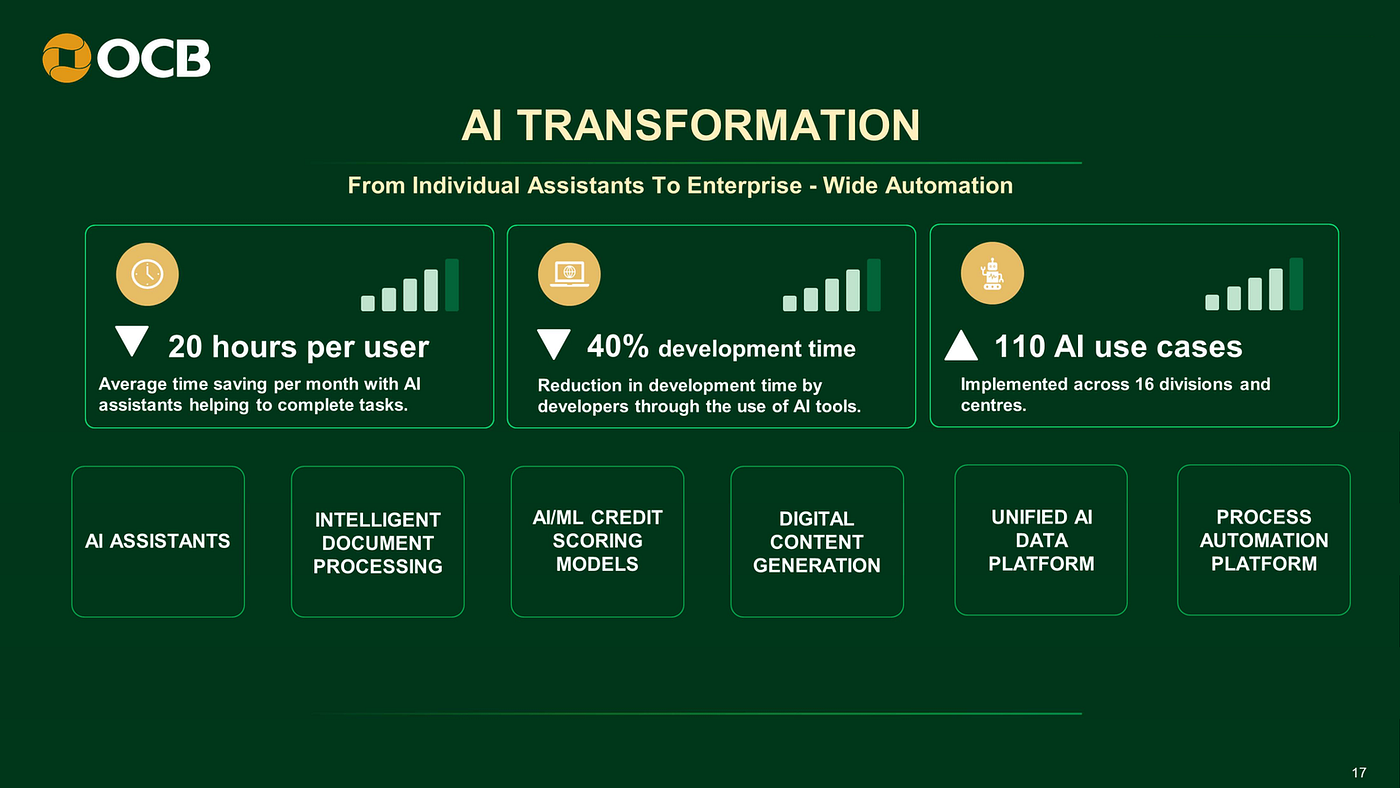
Twenty hours a month is half a working week given back to each person using these tools. I find the 110 use cases less interesting than the six things underneath them on the slide: AI assistants, intelligent document processing, AI and ML credit scoring, digital content generation, a unified AI data platform and a process automation platform.
In Iran, where I was born, villages in the desert survived for centuries on qanats: underground channels dug to carry water from distant aquifers to every field and house. Nobody admired a qanat. You admired the orchard. But the orchard existed because the channel was there, quietly, beneath everything.
The unified data platform is our qanat. The 110 use cases are the orchard. If we had built 110 separate wells, we would have 110 things to maintain, 110 data definitions that disagree, and no reason to expect the 111th to be any cheaper than the first. Because they share the same channel, they compound.
The bank that knows you
Digital content hyper-personalization
These are real screens from OCB OMNI. Each customer sees a different offer, in a different visual language, at a different moment: a cash back message for someone who pays internationally, Flex Fund for someone with unused credit limit, bill payment for someone whose bills are due.
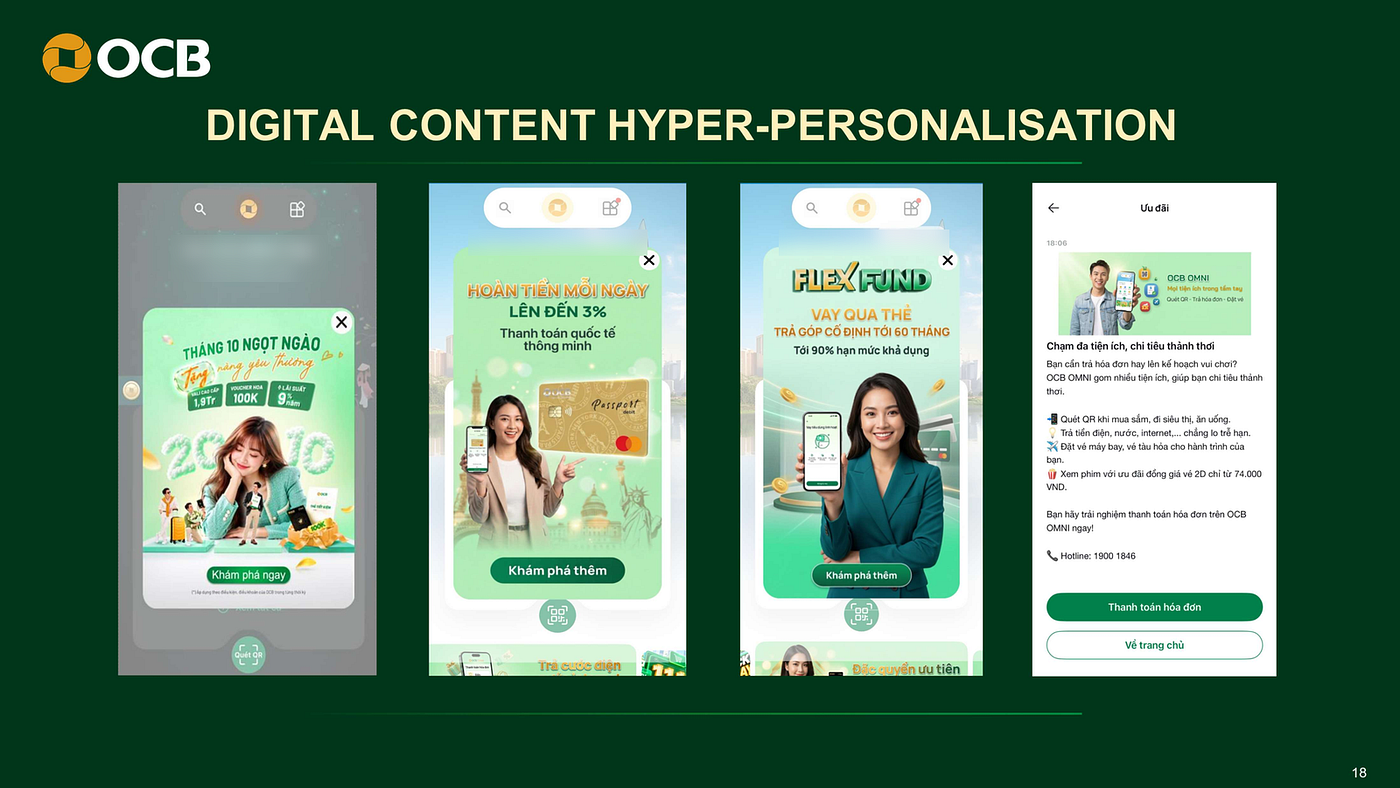
Behavioural economists have a well-known rule for changing behaviour: make it easy. Most of what we call personalisation is really the removal of irrelevance. A customer who sees one offer that fits is more likely to act than one who scrolls past ten that do not.
What the customers did
Digital adoption and engagement
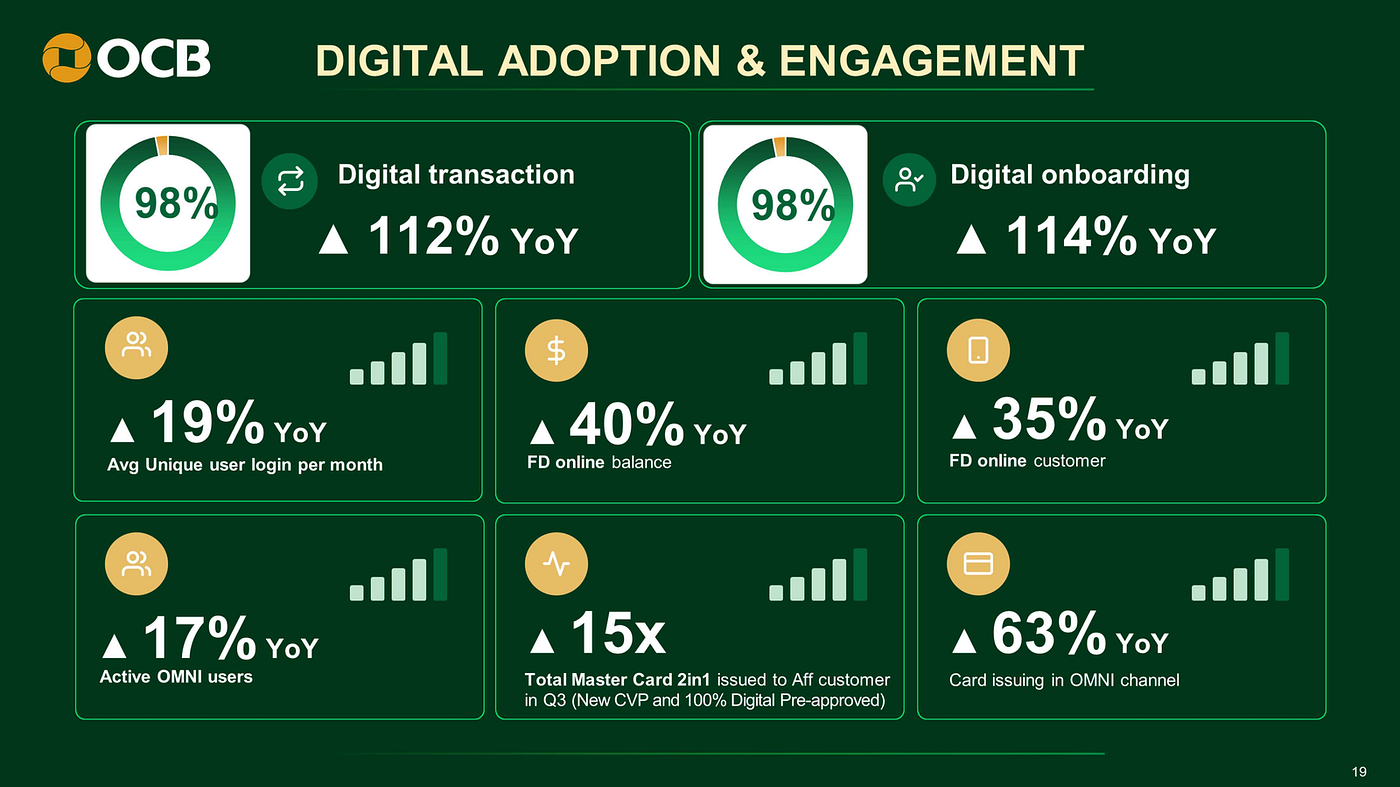
The 15x is the number I would pull out. In July we relaunched the OCB Mastercard World 2in1, a single card with credit and debit functions, cashback, a 0.9% foreign exchange fee and premium travel privileges. The proposition got better, but the bigger change was the journey: fully digital and pre-approved for eligible customers. Issuance in Q3 rose fifteen times.
I have built enough card products to know that a better proposition behind a slow, paper-heavy journey usually grows by a percentage. Remove the friction and the same proposition grows by a multiple.
Customers do not reward features. They reward the absence of friction.
Speed is the product
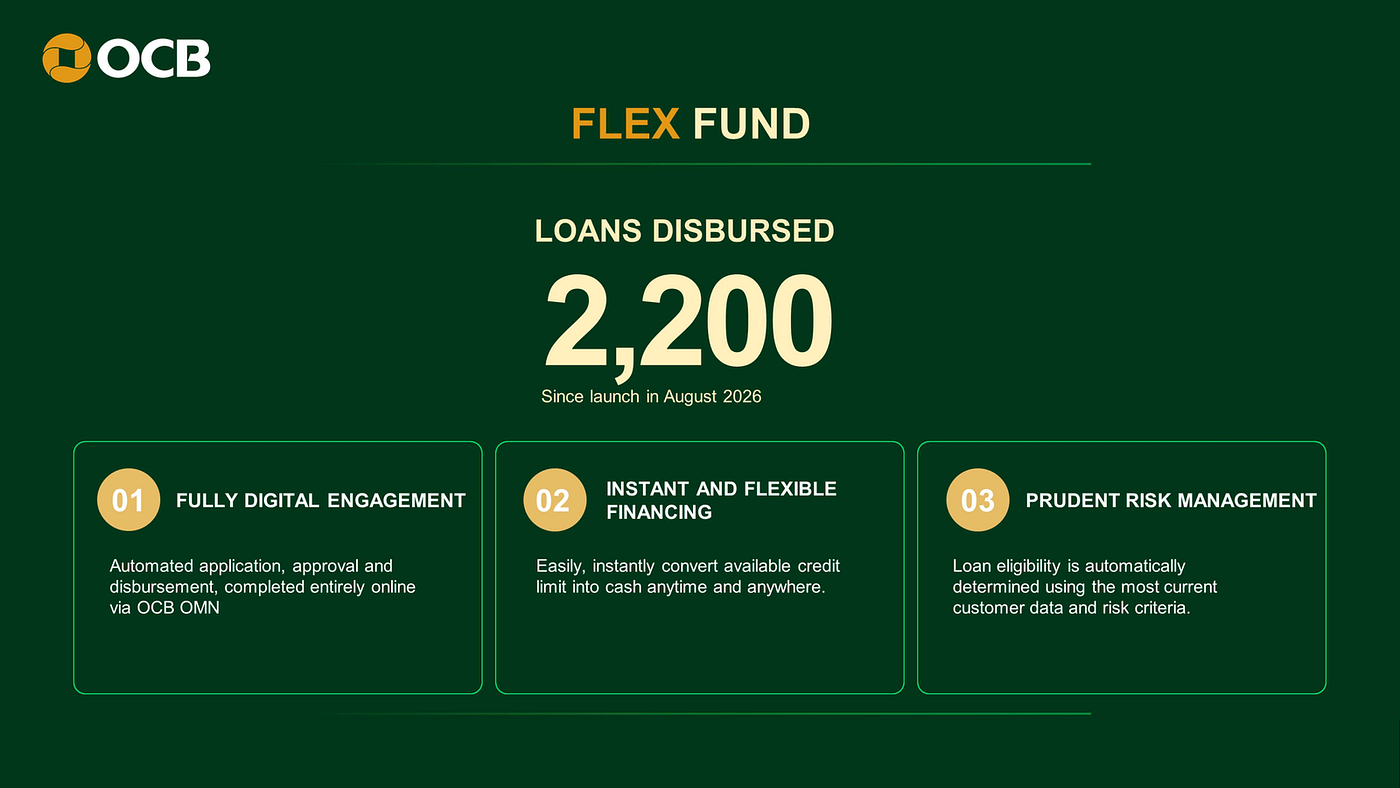
Flex Fund: 2,200 loans disbursed since launch in August 2026
Flex Fund lets a customer turn available card limit into cash, inside OMNI, with automated application, approval and disbursement. Eligibility is decided automatically using current customer data and risk criteria. Since launch in August 2026 we have disbursed 2,200 loans.
What I want to emphasise is not Flex Fund itself. It is that one team went from customer need to design, technology integration, deployment at scale and risk control in a short cycle. That capability is reusable. The product is just the first thing it produced.
Flexi Savings: deposit balance up 87% quarter on quarter
Flexi Savings, which we introduced at our second-quarter results, is the deposit side of the same story:
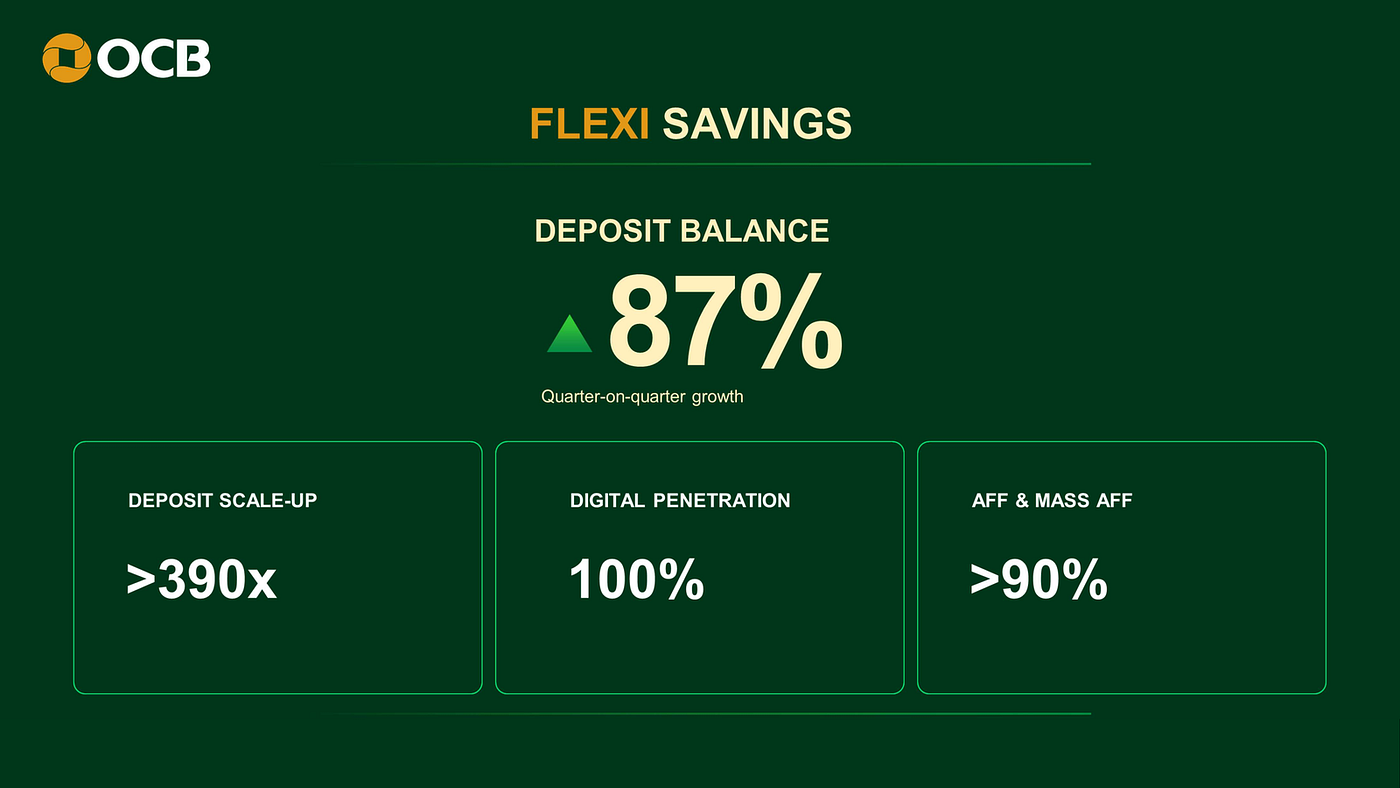
Customers wanted flexibility with idle cash without giving up yield. When we gave it to them, the people who moved most were the ones with the most money to move.
The people behind the numbers
Every figure in this post has a name behind it, usually several, and none of them is mine.
The 110 use cases live in 16 divisions and centres because people in those divisions decided to try something new on top of a full day job. Retail Banking, Transformation Office, Treasury, Finance, Legal, Corporate Banking and SME teams redesigned journeys they had run the same way for years. Risk Management sat with data scientists and argued, patiently, about what a good model should and should not be allowed to do. Finance rebuilt reports so the numbers could be trusted by machines as well as people. Technology, Data and Digital built the platforms, often at night, often twice. Operations, Marketing, Legal and Compliance, HR and the branch network made sure what we built could actually reach a customer, safely, and that our people were ready to use it.
Flex Fund did not ship in a short cycle because of a tool. It shipped because product, risk, technology and operations sat in the same room and treated each other’s constraints as their own. The 15x on the 2in1 card is the sum of hundreds of small decisions by people who will never see their names on a slide.
Back to the octopus. Its arms are the reason it is clever. At OCB, the arms are my colleagues. Thank you, all of you.
What I am still unsure about
I do not want to pretend this is finished. A few questions keep me up.
When intelligence lives in the arms, how do you keep the octopus coherent? Sixty citizen data scientists will produce sixty versions of the truth unless the definitions underneath them are shared and governed. Democratizing data without governing it is just a faster way to disagree.
Credit models that learn continuously are only as good as the humans watching them. The day a model drifts is rarely the day anyone notices.
And personalisation has an ethical edge. A bank that knows you well enough to make the right offer also knows you well enough to make the wrong one at your weakest moment. The bank that knows you has to be the bank that is careful with what it knows.
Twenty hours a month back per person is real. The question I keep asking is what we do with those hours. If we spend them making more of the same, we will have built a faster version of the old bank. If we spend them on the problems nobody had time for, we may find out what an AI-native bank actually is.
I am not sure yet which one we are building. I suspect the answer will show up in the numbers a year from now.